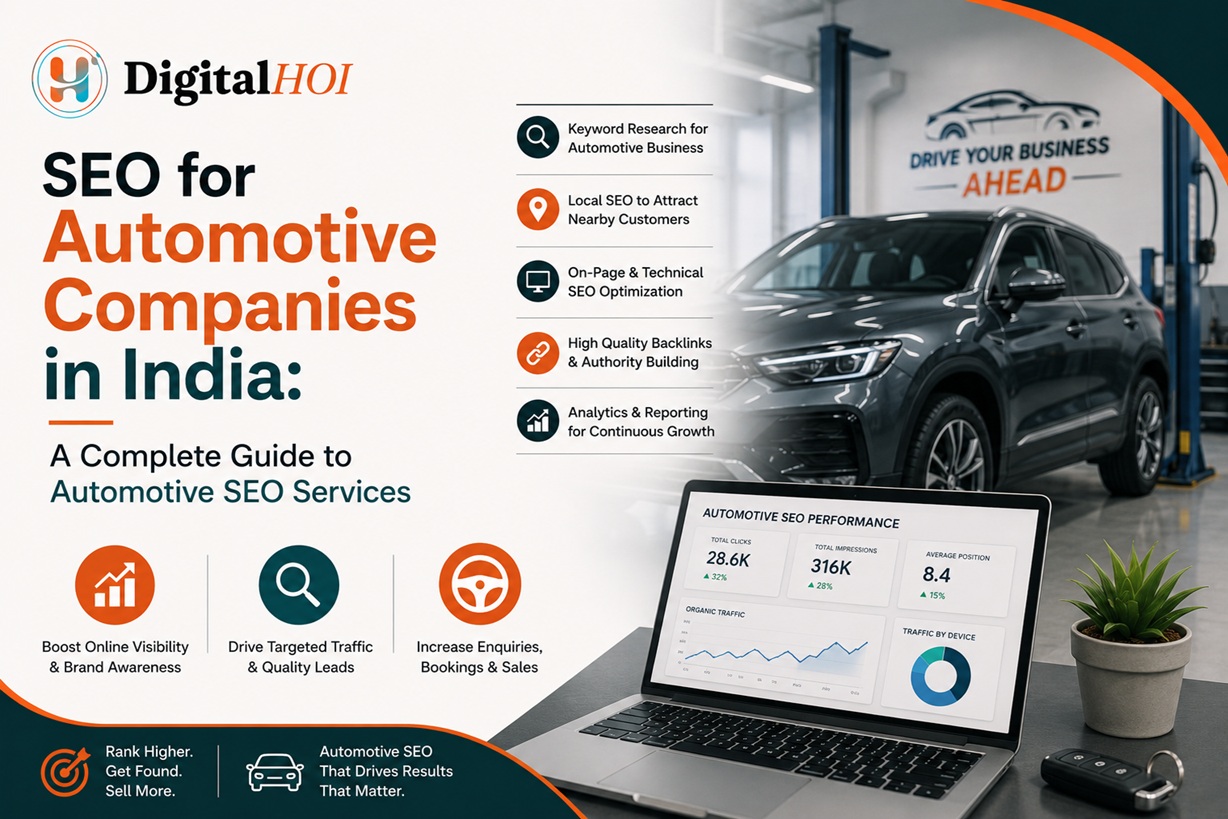
Key Takeaway
Automotive SEO is no longer simply about ranking a car company website on Google.
Today's automotive customer searches throughout the entire buying and ownership journey.
They search for vehicles, models, specifications, prices, comparisons, dealerships, financing, service centres, spare parts, repairs, EV information, and ownership advice.
That creates multiple organic opportunities for automotive businesses.
A successful strategy connects:
Search Demand → Automotive Content → Product & Service Pages → Local/National Visibility → Qualified Enquiries → Business Growth
For automotive companies in India, SEO can become a long-term acquisition channel that supports vehicle discovery, dealership visits, test drives, service bookings, parts sales, B2B enquiries, and customer acquisition.
The ultimate goal is not simply more rankings.
It is:
More Relevant Search Visibility → More Qualified Visitors → More Automotive Enquiries → More Customers → Sustainable Growth
Introduction
The automotive buying journey has changed significantly.
Customers no longer depend entirely on visiting dealerships to discover vehicles.
Before walking into a showroom, many potential buyers research models, compare specifications, check prices, read reviews, watch demonstrations, explore financing options, compare competitors, and search for nearby dealerships.
All of these activities can begin with a Google search.
The same applies after purchasing a vehicle.
Customers search for service centres, spare parts, accessories, maintenance information, repair solutions, insurance, tyres, batteries, and other automotive services online.
This makes search visibility increasingly important for automotive businesses.
SEO for automotive companies helps businesses appear during these critical moments and connect their products or services with customers who are actively searching for them.
What Is Automotive SEO?
Automotive SEO is the process of improving the online visibility of businesses operating in the automotive industry.
It involves optimizing websites, product pages, service pages, dealership profiles, location pages, content, technical infrastructure, and online business profiles so that they can appear for relevant search queries.
Automotive SEO can be used by:
- Automobile manufacturers
- Car dealerships
- Two-wheeler dealerships
- Commercial vehicle companies
- Automotive distributors
- Auto parts manufacturers
- Spare-parts retailers
- Car service centres
- Automobile repair shops
- Tyre companies
- Battery companies
- EV companies
- Automotive software companies
- Automotive technology providers
- Car rental companies
- Automotive finance businesses
The exact SEO strategy depends on the business model and target audience.
Why SEO Matters for the Automotive Industry
Automotive purchases involve extensive research.
A customer may spend days or weeks researching a vehicle before making a purchase.
During this period, they may perform dozens of searches.
They might search for a particular model, compare two vehicles, look for prices, explore specifications, search for reviews, find dealerships, investigate financing, and eventually schedule a test drive.
This creates multiple opportunities for automotive businesses to appear in search results.
A strong SEO strategy allows a company to become visible at different stages rather than relying only on branded searches.
Understanding the Automotive Search Journey
Automotive search intent can generally be divided into several stages.
Vehicle Discovery
The customer is exploring available options.
Examples include:
best SUV in India
best electric cars
best family cars
Model Research
The customer has identified a particular type of vehicle.
Examples include:
SUV under 15 lakh
electric car under 20 lakh
7 seater cars in India
Product Research
The customer is researching a specific vehicle.
Examples include:
[car model] specifications
[car model] mileage
[car model] features
Comparison
The customer is comparing alternatives.
Examples include:
Car A vs Car B
best SUV comparison
electric car comparison
Transactional Search
The customer is ready to take action.
Examples include:
car dealer near me
book a test drive
car showroom in Delhi
After-Sales Search
The customer already owns a vehicle.
Examples include:
car service centre near me
car battery replacement
car spare parts
A comprehensive automotive SEO strategy can target all of these stages.
Automotive Keyword Research
Automotive keyword research needs to go beyond generic keywords such as "cars" or "automobile."
The most valuable keywords often reveal a specific customer need.
Keyword research should cover:
Vehicle models
Vehicle categories
Specifications
Features
Prices
Comparisons
Dealerships
Locations
Services
Spare parts
Accessories
Repairs
Financing
Insurance
Electric vehicles
Commercial vehicles
Two-wheelers
Understanding these search patterns allows automotive companies to build pages that match actual customer intent.
SEO for Automotive Manufacturers
Automotive manufacturers operate at a national or international scale.
Their websites can contain hundreds or thousands of pages covering vehicle models, variants, features, specifications, technologies, dealerships, service networks, and accessories.
For manufacturers, SEO should create a clear hierarchy between:
Brand → Vehicle Category → Model → Variant → Feature → Location → Dealer
Each important page should have a distinct search purpose.
Manufacturers can also build content around automotive technology, safety, fuel efficiency, EV technology, vehicle maintenance, ownership, and customer education.
SEO for Car Dealerships
Car dealerships have a strong local SEO opportunity.
Customers frequently search for dealerships using location-based queries.
Examples include:
car showroom in Bhubaneswar
car dealer in Mumbai
car dealership near me
[brand] dealer in Delhi
[brand] showroom in Pune
Dealership SEO should therefore combine website optimization with Google Business Profile optimization, location pages, reviews, local content, and accurate business information.
Local SEO for Automotive Businesses
Local search is extremely important for dealerships, workshops, service centres, tyre shops, battery dealers, car rental companies, and automobile repair businesses.
A customer who searches for:
car service near me
car repair shop near me
tyre shop near me
car showroom near me
is often demonstrating strong commercial intent.
Automotive local SEO helps businesses become more visible for these location-based searches.
Google Business Profile for Automotive Businesses
Google Business Profile can play an important role in automotive local SEO.
Automotive businesses should ensure that their profile contains accurate information about:
Business name
Address
Phone number
Business category
Services
Operating hours
Photos
Website
Customer reviews
The profile should also remain updated as services, locations, or operating hours change.
For dealerships and service centres, reviews can also influence customer confidence when people are comparing nearby businesses.
Location Pages for Automotive Companies
Automotive companies operating across multiple cities can create dedicated location pages.
For example, a dealership network could have pages targeting:
Car dealership in Bhubaneswar
Car dealership in Delhi
Car dealership in Bengaluru
Car dealership in Hyderabad
These pages should provide genuine location-specific information.
Simply creating hundreds of pages with identical content and changing only the city name can result in a poor user experience.
Automotive Product Page SEO
Vehicle model pages are among the most important SEO assets for manufacturers and dealers.
A strong vehicle page should clearly communicate:
Model information
Features
Specifications
Variants
Technology
Safety
Performance
Fuel type
Electric range where applicable
Pricing information where appropriate
Images
Frequently asked questions
Booking or enquiry options
The page should be structured around the questions potential buyers actually ask.
SEO for Electric Vehicle Companies
The growth of electric mobility has created new search opportunities.
Customers are searching for information about:
electric cars in India
EV scooters
electric vehicles
EV charging
EV range
EV battery life
electric car price
EV maintenance
electric vehicle charging stations
EV companies can build organic visibility by creating product pages, educational resources, comparison content, charging guides, ownership resources, and location-based pages.
SEO for Two-Wheeler Companies
Two-wheeler companies can target searches around motorcycles, scooters, electric scooters, commuter bikes, performance bikes, specifications, mileage, prices, comparisons, dealerships, and service centres.
Search intent can vary considerably between a person researching a vehicle and someone ready to visit a dealership.
A strong SEO strategy should address both.
SEO for Commercial Vehicle Companies
Commercial vehicle buyers often have very specific requirements.
They may search based on:
Vehicle type
Load capacity
Fuel type
Mileage
Application
Business use
Payload
Vehicle dimensions
Price
Financing
Service support
Commercial vehicle manufacturers can build dedicated content around these use cases.
For B2B automotive businesses, SEO can become an important channel for reaching fleet operators, logistics companies, transport businesses, distributors, and other commercial customers.
SEO for Auto Parts Companies
The automotive aftermarket provides significant ecommerce and search opportunities.
Customers search for:
car spare parts
brake pads
car batteries
engine parts
automotive accessories
replacement parts
car filters
tyres
Auto parts companies should optimize individual product pages, categories, compatibility information, vehicle-specific pages, and educational resources.
Vehicle compatibility information can be particularly valuable because customers want to know whether a specific part works with their vehicle.
Ecommerce SEO for Automotive Businesses
Automotive ecommerce websites can contain thousands of products.
This makes technical SEO particularly important.
Ecommerce automotive SEO should focus on:
Product pages
Category pages
Vehicle-specific categories
Product attributes
Compatibility pages
Filters
Internal linking
Canonical URLs
Structured data
Product information
User reviews
Technical performance
A clear site architecture can help search engines understand the relationship between vehicles, categories, products, and applications.
Automotive Service Centre SEO
Automotive service centres can use SEO to capture customers searching for maintenance and repair services.
Potential searches include:
car service centre near me
car AC repair
car brake repair
wheel alignment near me
car denting and painting
engine repair
car maintenance service
Dedicated service pages can target individual services while local SEO captures customers searching within the service area.
Automotive Content Marketing
Automotive businesses have enormous opportunities for educational content.
Customers have questions before and after purchasing a vehicle.
Content can address topics such as:
How to choose a car
How to compare vehicles
How to calculate vehicle ownership costs
How to maintain a car
When to replace tyres
How EV charging works
How to improve fuel efficiency
How to choose car insurance
How to prepare a vehicle for long-distance travel
The best content should answer genuine customer questions rather than simply repeat keywords.
Automotive Comparison Content
Comparison searches are highly relevant to vehicle buyers.
Potential customers may compare:
SUV vs Sedan
Petrol vs Diesel
EV vs Petrol
Automatic vs Manual
Car A vs Car B
New car vs Used car
Comparison content can help brands attract customers who are already evaluating options.
It should remain factual and transparent, especially when comparing products from different manufacturers.
Automotive SEO and Used Car Businesses
Used-car platforms and dealerships can build SEO visibility around searches involving:
Used cars
Second-hand cars
Used cars by city
Used cars by budget
Used SUVs
Used electric cars
Used commercial vehicles
Certified pre-owned cars
Used car valuation
Car resale value
Dedicated landing pages and inventory optimization can help capture highly specific search demand.
Technical SEO for Automotive Websites
Automotive websites can become technically complex.
Large manufacturers and dealerships may have thousands of pages.
Ecommerce auto-parts websites can have even larger inventories.
Technical SEO should address:
Crawlability
Indexation
URL structure
Duplicate content
Canonical URLs
Faceted navigation
Pagination
XML sitemaps
Structured data
Page speed
Mobile usability
JavaScript rendering
Internal linking
Redirects
Proper technical architecture prevents valuable pages from becoming difficult for search engines to discover or understand.
Automotive SEO and Structured Data
Structured data can help search engines understand important information on automotive websites.
Depending on the page and business model, relevant structured data may include:
Organization
Local Business
Product
Review
Breadcrumb
FAQ where appropriate
Using structured data correctly can improve machine understanding of a website and may support eligible search features.
It should always accurately represent visible page content.
Building E-E-A-T for Automotive Websites
Automotive customers are making significant purchasing decisions.
Trust matters.
Automotive businesses can strengthen credibility through:
Expert authors
Vehicle experts
Detailed specifications
Original testing
Customer reviews
Ownership guides
Case studies
Transparent pricing information
Company information
Dealer information
Warranty information
Service information
Original photography
Expert commentary
For technical automotive content, demonstrating real-world experience can make the content more useful and credible.
Link Building for Automotive SEO
Automotive businesses can build authority through relevant publications and industry websites.
Potential opportunities include automotive media, industry publications, technology websites, business publications, automotive associations, local media, supplier partnerships, and original research.
For example, an automotive company could publish original research on:
EV adoption
Vehicle ownership costs
Automotive consumer trends
Charging infrastructure
Vehicle maintenance
Mobility trends
Original data can attract media coverage and relevant backlinks.
Automotive SEO and AI Search
Search behavior is changing as users increasingly interact with AI-powered search experiences.
Customers may ask AI systems questions such as:
Which SUV is best for a family?
What should I consider before buying an EV?
How much does it cost to maintain an electric vehicle?
Which car is suitable for city driving?
Automotive businesses can prepare by creating clear, accurate, well-structured content that directly answers customer questions.
Detailed specifications, FAQs, comparison resources, expert explanations, ownership guides, and original research can all contribute to a stronger information footprint.
Automotive SEO and Lead Generation
SEO should ultimately support automotive business objectives.
Depending on the business, conversions may include:
Test-drive requests
Vehicle enquiries
Dealer calls
Showroom visits
Booking requests
Service bookings
Parts enquiries
Quote requests
Finance enquiries
Insurance enquiries
Product purchases
The website should make these actions easy to complete.
Conversion Rate Optimization for Automotive Websites
Automotive websites need to convert search traffic into meaningful actions.
Strong conversion elements can include:
Clear enquiry buttons
Test-drive forms
Dealer locator
Service booking forms
WhatsApp or call options
Vehicle comparison tools
Price information
Financing calculators
EMI calculators
Brochure downloads
Product demonstrations
Customer reviews
The conversion path should be simple, especially on mobile devices.
Mobile SEO for Automotive Businesses
Automotive searches are frequently performed on mobile devices.
A customer may search for a dealership while travelling.
Someone may look for a nearby service centre from their phone.
A potential buyer may compare vehicle specifications on a smartphone.
Therefore, automotive websites should provide a fast and intuitive mobile experience.
Important information should be easy to find without excessive scrolling or complicated navigation.
How to Do SEO for Automotive Companies
An effective automotive SEO campaign should begin with business and market research.
First, identify the company's products, services, locations, customer segments, competitors, and commercial goals.
Next, conduct automotive keyword research based on products, vehicle models, services, locations, customer problems, and search intent.
Then build an SEO architecture that connects category pages, product pages, service pages, location pages, and educational content.
Technical SEO should be addressed before scaling content.
Content should then be developed around customer questions and commercial opportunities.
Local SEO should support dealerships and service locations.
Authority building and digital PR can strengthen domain credibility.
Finally, SEO performance should be connected to enquiries, bookings, leads, and sales opportunities.
Automotive SEO Strategy for Different Business Types
Automotive Manufacturers
Focus on vehicle model pages, product categories, specifications, features, technology, ownership content, dealerships, and national search visibility.
Car Dealerships
Focus heavily on local SEO, dealership pages, vehicle inventory, test-drive enquiries, reviews, Google Business Profile optimization, and location-based searches.
Auto Parts Companies
Focus on ecommerce SEO, product pages, category pages, vehicle compatibility, product attributes, and transactional searches.
Automotive Service Centres
Focus on local SEO, service pages, repair-related searches, reviews, and appointment conversions.
EV Companies
Focus on EV products, charging, battery technology, ownership, range, comparisons, incentives where applicable, and educational content.
Automotive B2B Companies
Focus on industry-specific solutions, applications, product specifications, supplier searches, technical resources, and lead generation.
Common Automotive SEO Mistakes
Optimizing Only for Brand Keywords
Brand searches are important, but relying entirely on branded traffic limits organic growth opportunities.
Creating Thin Model Pages
Vehicle pages need useful information that actually helps potential customers.
Ignoring Local Search
Dealerships and service businesses can lose significant opportunities by neglecting Google Maps and location-based searches.
Creating Duplicate Location Pages
Location pages should provide unique, useful information rather than simply changing city names.
Ignoring Technical SEO
Large automotive websites can accumulate serious crawl and indexation problems.
Focusing Only on Traffic
High traffic doesn't necessarily mean more vehicle enquiries or sales.
Automotive SEO should ultimately connect search performance with business outcomes.
How Much Do Automotive SEO Services Cost in India?
The cost of automotive SEO services in India depends on the business model, website size, target market, competition, number of products or locations, content requirements, and SEO objectives.
A local automobile service centre may require a focused local SEO campaign.
A dealership network may require multi-location SEO.
An automobile manufacturer or large automotive ecommerce company may require enterprise-level technical SEO, content, product optimization, and authority building.
Therefore, SEO investment should be based on the scale and complexity of the opportunity rather than a one-size-fits-all package.
How Long Does Automotive SEO Take?
Automotive SEO is generally a long-term strategy.
Local businesses may see improvements in local visibility as their Google Business Profile, website, citations, reviews, and local relevance improve.
National automotive brands competing for highly competitive vehicle keywords may require considerably more time and authority.
Results depend on the website's existing authority, technical condition, competition, content quality, search demand, target locations, and consistency of execution.
The objective should be sustainable organic visibility rather than temporary ranking gains.
How to Choose an Automotive SEO Company in India
Choosing the right automotive SEO company requires an understanding of the industry's unique search behavior.
The agency should be able to demonstrate experience with:
Automotive keyword research
Local SEO
National SEO
Technical SEO
Product SEO
Ecommerce SEO
Content strategy
Automotive website architecture
Lead generation
Conversion optimization
Digital PR
Authority building
Ask how the agency plans to connect rankings with real business outcomes such as test-drive requests, service bookings, dealership enquiries, parts sales, and qualified leads.
A good automotive SEO agency should build a strategy around your business model rather than applying the same SEO checklist to every automotive company.
Why Choose DigitalHOI for Automotive SEO Services?
DigitalHOI develops SEO strategies designed to help automotive businesses improve search visibility, attract relevant customers, and generate measurable business opportunities.
Our automotive SEO services can include technical SEO, automotive keyword research, local SEO, national SEO, product SEO, ecommerce SEO, content marketing, location SEO, Google Business Profile optimization, internal linking, authority building, digital PR, and conversion optimization.
We can create customized SEO strategies for automotive manufacturers, car dealerships, two-wheeler companies, EV businesses, commercial vehicle companies, auto-parts businesses, service centres, automobile repair companies, automotive technology providers, and automotive B2B companies.
The strategy is built around the customer's search journey—from vehicle discovery and product research to dealership searches, service requirements, parts searches, and purchase decisions.
DigitalHOI is a sub-brand of High-On Innovation, combining digital marketing and technology expertise to help businesses build sustainable digital growth.
Frequently Asked Questions
What is automotive SEO?
Automotive SEO is the process of optimizing an automotive company's website and online presence to improve visibility for searches related to vehicles, products, dealerships, services, parts, repairs, and automotive solutions.
Why do automotive companies need SEO?
Customers conduct extensive online research before purchasing vehicles or selecting automotive services. SEO helps automotive businesses become visible during these searches and generate relevant enquiries.
Can SEO help car dealerships?
Yes. Local SEO can help dealerships improve visibility for searches such as car dealers, showrooms, test drives, and vehicle-related searches within their target locations.
Is local SEO important for automotive businesses?
Yes. Local SEO is particularly important for dealerships, workshops, service centres, tyre shops, battery dealers, and other businesses that serve customers in specific geographic areas.
Can SEO help automotive manufacturers?
Yes. Manufacturers can use SEO to improve visibility for vehicle models, specifications, features, technologies, comparisons, ownership information, dealerships, and other automotive searches.
How does SEO help EV companies?
EV companies can target searches related to electric vehicles, charging, battery technology, range, maintenance, pricing, comparisons, and EV ownership.
Can automotive SEO increase leads?
Yes. SEO can generate test-drive requests, vehicle enquiries, service bookings, parts enquiries, dealer calls, quote requests, and other qualified opportunities when combined with effective conversion optimization.
How long does automotive SEO take?
The timeline varies according to competition, website authority, technical SEO, content quality, target keywords, locations, and business scale. Competitive automotive keywords generally require a sustained SEO strategy.
Ready to Grow Your Automotive Business Through SEO?
If your automotive company wants to improve Google visibility, attract qualified customers, and generate more enquiries, DigitalHOI can develop an automotive SEO strategy aligned with your products, locations, target customers, and growth objectives.
Explore DigitalHOI SEO Services
Author
Sachikanta Mohanty – Digital Marketing Manager & Lead Strategist, High-On Innovation
Sachikanta Mohanty is the Digital Marketing Manager and Lead Strategist at High-On Innovation, specializing in SEO, content strategy, digital transformation marketing, lead generation, performance marketing, and online brand growth. He develops data-driven strategies that help businesses improve visibility, customer acquisition, and long-term digital growth.