Key Takeaways
-
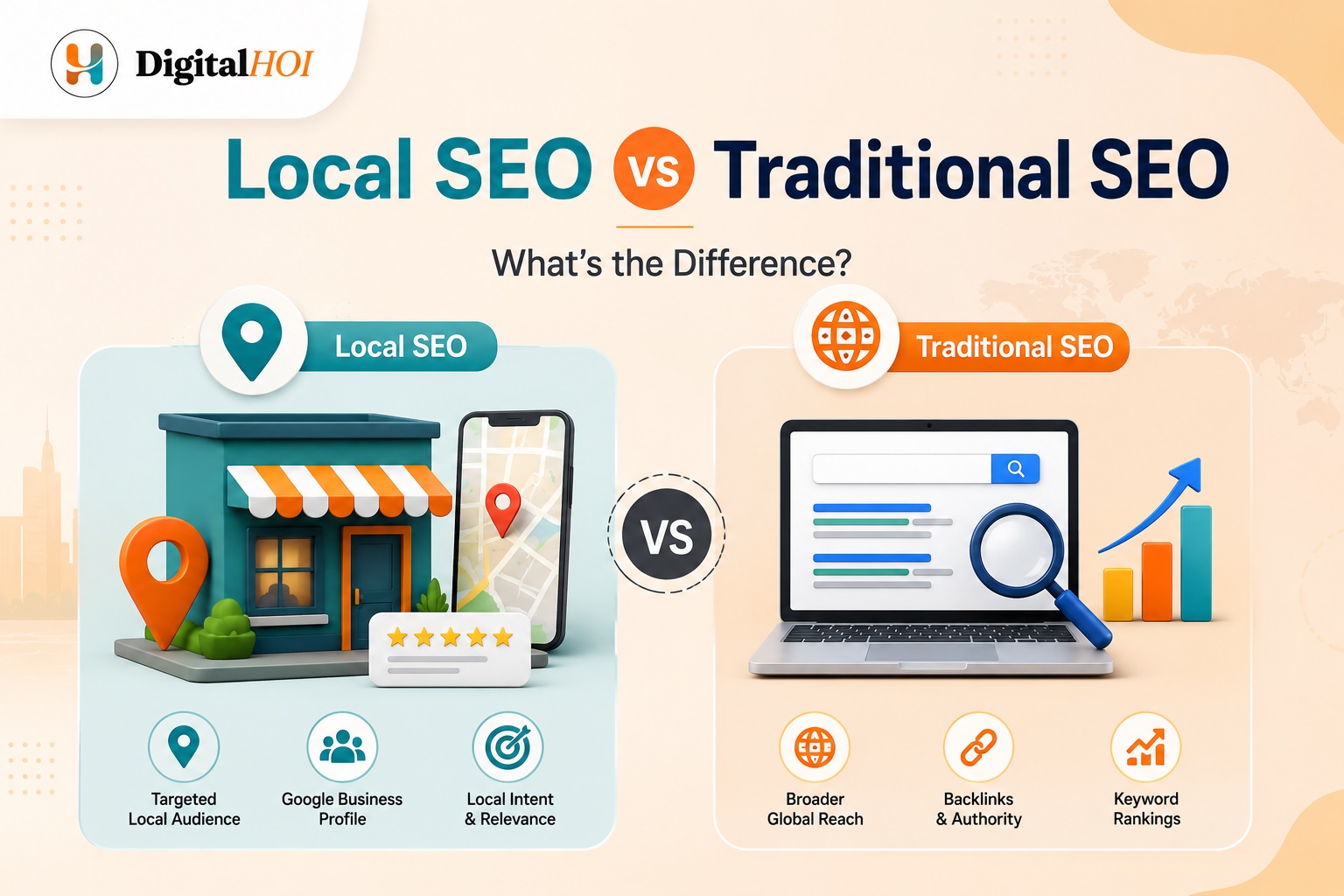
Local SEO focuses on attracting customers within specific geographic areas, while Traditional SEO targets broader audiences.
-
Google Business Profile, reviews, local citations, and proximity are critical Local SEO ranking factors.
-
Traditional SEO relies more heavily on content quality, backlinks, technical SEO, and website authority.
-
Local SEO keywords typically include cities, regions, or location-based phrases.
-
Traditional SEO targets broader industry and commercial search terms.
-
Businesses serving local customers should prioritize Local SEO.
-
Businesses targeting nationwide or global audiences should invest in Traditional SEO.
-
Many organizations achieve the best results by combining both Local SEO and Traditional SEO strategies.
Local SEO vs Traditional SEO: What's the Difference?
Search Engine Optimization (SEO) is one of the most effective ways to increase online visibility, attract potential customers, and grow a business. However, not all SEO strategies are the same.
Many business owners hear terms like Local SEO, Traditional SEO, Organic SEO, and National SEO and assume they all mean the same thing. While they share similar principles, their goals, target audiences, and optimization strategies are quite different.
Understanding the difference between Local SEO and Traditional SEO is essential for choosing the right approach for your business.
Whether you operate a local service business, a nationwide company, or an ecommerce store, selecting the appropriate SEO strategy can significantly impact your online growth.
What is Local SEO?
Local SEO focuses on improving a business's visibility in location-based search results.
The goal is to help businesses appear when people search for products or services within a specific geographic area.
Examples include:
-
Dentist in Delhi
-
Restaurant near me
-
Real Estate Agent in Mumbai
-
Digital Marketing Agency in Bhubaneswar
-
Gym near me
Local SEO helps businesses rank in:
-
Google Maps
-
Google Business Profile Listings
-
Local Pack Results
-
Location-Based Organic Searches
It is primarily designed for businesses that serve customers within a city, region, or service area.
What is Traditional SEO?
Traditional SEO, often referred to as Organic SEO, focuses on improving rankings in standard search engine results regardless of geographic location.
The objective is to increase visibility for broader search terms that can attract visitors from across a country or even globally.
Examples include:
-
SEO Services
-
CRM Software
-
Project Management Tools
-
Ecommerce Marketing
-
Digital Marketing Strategies
Traditional SEO targets larger audiences and emphasizes website authority, content relevance, and overall search performance.
Local SEO vs Traditional SEO: Key Differences
Although both strategies aim to improve search visibility, they differ in several important ways.
|
Factor |
Local SEO |
Traditional SEO |
|
Target Audience |
Customers in a specific location |
Customers across a wider geographic area |
|
Search Intent |
Location-based searches |
General informational or commercial searches |
|
Google Maps |
Major ranking factor |
Not applicable |
|
Google Business Profile |
Critical for success |
Usually not required |
|
Local Pack Visibility |
Important |
Not relevant |
|
Geographic Focus |
City, region, or service area |
National or global reach |
|
Keyword Strategy |
Location-based keywords |
Broad industry keywords |
|
Citation Building |
Important |
Limited impact |
|
Reviews |
Strong ranking factor |
Indirect influence |
|
Competition |
Local competitors |
National or industry-wide competitors |
Search Intent: The Biggest Difference
One of the most important distinctions between Local SEO and Traditional SEO is user intent.
Local Search Intent
Users searching locally often have immediate purchasing intentions.
Examples:
-
Dentist near me
-
Best restaurant in Chandigarh
-
Car repair shop in Delhi
These users are typically ready to:
-
Make a phone call
-
Visit a location
-
Book an appointment
-
Request a quote
Traditional Search Intent
Traditional SEO often targets users earlier in the buying journey.
Examples:
-
Best CRM Software
-
SEO Strategies
-
Ecommerce Marketing Guide
These searches may involve:
-
Research
-
Product comparison
-
Information gathering
-
Long-term purchasing decisions
Understanding intent helps businesses develop the right SEO strategy.
Google Business Profile: A Major Local SEO Factor
One of the defining features of Local SEO is the use of Google Business Profile.
An optimized profile helps businesses appear in:
-
Google Maps
-
Local Search Results
-
Mobile Searches
-
Google's Local Pack
Key optimization areas include:
-
Business categories
-
Contact information
-
Reviews
-
Photos
-
Services
-
Business descriptions
Traditional SEO campaigns typically do not rely on Google Business Profile as a primary ranking factor.
Keyword Targeting Differences
Keyword strategies vary significantly between Local SEO and Traditional SEO.
Local SEO Keywords
Local SEO targets location-specific searches.
Examples:
-
Dentist in Mumbai
-
Accountant in Delhi
-
SEO Company in Bhubaneswar
These keywords usually include:
-
Cities
-
Neighborhoods
-
Service Areas
-
"Near Me" phrases
Traditional SEO Keywords
Traditional SEO focuses on broader search terms.
Examples:
-
SEO Services
-
Content Marketing
-
Business Consulting
These keywords often have:
-
Higher search volume
-
Greater competition
-
Broader audiences
Ranking Factors: Local SEO vs Organic SEO
Both strategies rely on core SEO principles such as content quality and technical optimization. However, certain ranking signals are more important for Local SEO.
Important Local SEO Ranking Factors
-
Google Business Profile Optimization
-
Customer Reviews
-
Business Categories
-
NAP Consistency
-
Local Citations
-
Google Maps Signals
-
Location-Based Content
-
Proximity to Searcher
Important Traditional SEO Ranking Factors
-
Content Quality
-
Backlinks
-
Website Authority
-
Technical SEO
-
User Experience
-
Internal Linking
-
Search Intent Alignment
-
Content Relevance
Content Strategy Differences
Content plays a major role in both SEO approaches, but the focus differs.
Local SEO Content
Examples include:
-
City Landing Pages
-
Service Area Pages
-
Local Guides
-
Community Resources
-
Local Event Content
The goal is to establish geographic relevance.
Traditional SEO Content
Examples include:
-
Industry Blogs
-
Case Studies
-
Educational Resources
-
Product Comparisons
-
Thought Leadership Articles
The goal is to build authority and attract a broader audience.
Which Businesses Need Local SEO?
Local SEO is ideal for businesses that depend on customers within specific geographic areas.
Examples include:
Healthcare Providers
-
Dentists
-
Clinics
-
Physiotherapists
Home Service Businesses
-
Electricians
-
Plumbers
-
Contractors
Professional Services
-
Lawyers
-
Accountants
-
Consultants
Retail & Hospitality
-
Restaurants
-
Hotels
-
Salons
If customers visit your location or you serve specific service areas, Local SEO should be a priority.
Which Businesses Need Traditional SEO?
Traditional SEO is more suitable for businesses targeting customers nationwide or globally.
Examples include:
SaaS Companies
Software businesses serving customers regardless of location.
Ecommerce Stores
Online retailers selling products across multiple regions.
Digital Products
Businesses offering online courses, memberships, or digital services.
National Service Providers
Organizations operating across India or internationally.
Can Businesses Use Both Strategies?
Absolutely.
Many businesses benefit from combining Local SEO and Traditional SEO.
For example:
A digital marketing agency may want to:
-
Rank locally for "SEO Company in Bhubaneswar"
-
Rank nationally for "SEO Services India"
Similarly, a healthcare organization with multiple locations may use Local SEO for individual clinics while implementing broader SEO strategies to strengthen overall brand authority.
Combining both approaches often delivers the best long-term results.
Common Misconceptions About Local SEO
Local SEO Is Only for Small Businesses (False).
Multi-location enterprises and large organizations often invest heavily in Local SEO.
Traditional SEO Replaces Local SEO (False).
Businesses targeting local customers still need dedicated Local SEO efforts.
Google Business Profile Is Enough (False).
While important, Google Business Profile works best when supported by website SEO, content, reviews, and citations.
Reviews Only Affect Reputation (False).
Reviews are also important Local SEO ranking signals.
Future Trends in Local and Organic SEO
Search continues to evolve rapidly.
Key trends include:
AI-Powered Search Experiences
Google increasingly uses AI to improve search relevance.
Voice Search
Location-based voice searches continue to grow.
Mobile-First Search
Mobile devices dominate local search behavior.
Entity-Based Search
Google is placing greater emphasis on understanding businesses as entities rather than simply matching keywords.
Hyperlocal Targeting
Search results are becoming increasingly personalized based on user location and intent.
Businesses that adapt to these trends will maintain stronger search visibility.
Which SEO Strategy is Right for Your Business?
The answer depends on where your customers are located and how they search for your products or services.
If your business depends on attracting customers from a specific city or region, investing in Local SEO Services can significantly improve your visibility in Google Maps and local search results.
If you're targeting customers across India, a broader SEO strategy may be more appropriate.
At DigitalHOI, we help businesses develop customized SEO strategies that align with their growth objectives, target audience, and market opportunities.