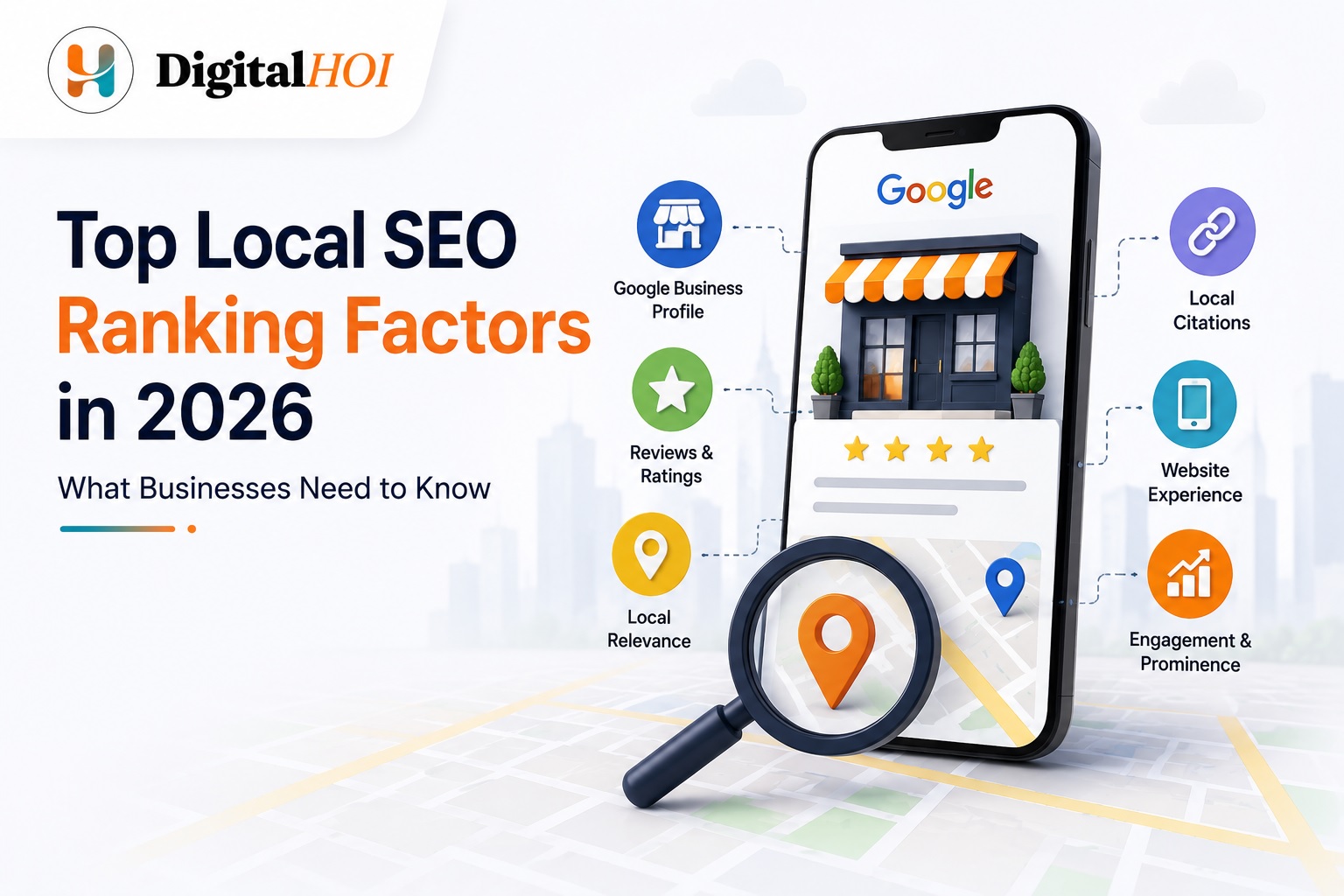
Key Takeaways
-
Local SEO rankings are influenced by relevance, distance, and prominence.
-
Google Business Profile optimization remains one of the most important local ranking factors.
-
Reviews, ratings, and review responses significantly impact visibility and trust.
-
Website quality, mobile experience, and technical SEO contribute to stronger local rankings.
-
Local keywords and location-specific landing pages help improve geographic relevance.
-
Consistent business information across directories strengthens trust signals.
-
Backlinks, local citations, and content marketing continue to support local SEO performance.
-
User engagement and Google Maps interactions increasingly influence local visibility.
-
Businesses that focus on both traditional SEO and local search optimization are more likely to achieve long-term success.
Top Local SEO Ranking Factors in 2026
Every day, millions of consumers search online for businesses, products, and services in their local area. Whether they're looking for a dentist, restaurant, law firm, real estate agent, or digital marketing agency, Google aims to deliver the most relevant and trustworthy local results.
For business owners, the challenge is understanding what factors influence these rankings and how to improve local visibility.
While Google's local search algorithm continues to evolve, certain ranking signals consistently play a significant role in determining which businesses appear in Google Search, Google Maps, and the Local Pack.
Understanding these Local SEO ranking factors can help businesses strengthen their online presence, attract more customers, and outperform local competitors.
How Google Determines Local Search Rankings
Google uses hundreds of ranking signals to determine local search visibility. However, these signals generally fall into three core categories:
Relevance
How closely your business matches the user's search query.
Distance
How close your business is to the searcher's location.
Prominence
How well-known, trusted, and authoritative your business appears online.
Every local SEO strategy should focus on improving these three areas.
1. Google Business Profile Optimization
How Google Business Profile impacts local rankings remains one of the strongest ranking factors in 2026.
A properly optimized profile helps Google understand:
-
What your business offers
-
Where your business operates
-
Which customers you serve
-
Why your business is relevant
Key optimization areas include:
-
Accurate business information
-
Primary and secondary categories
-
Business description
-
Services and products
-
Business hours
-
Photos and videos
-
Regular profile updates
Businesses with complete and actively managed profiles typically perform better in local search results.
2. Business Categories
Choosing the correct business category is one of the most influential ranking signals.
Your primary category tells Google exactly what your business does.
For example:
-
Dental Clinic
-
Restaurant
-
Real Estate Agency
-
Marketing Agency
Secondary categories can further strengthen relevance for additional services.
Selecting the wrong category can significantly limit local search visibility.
3. Customer Reviews and Ratings
Reviews continue to be a major local search ranking factor.
Google evaluates:
-
Number of reviews
-
Average rating
-
Review recency
-
Review diversity
-
Review responses
Positive reviews not only improve rankings but also influence customer decisions.
Businesses should actively encourage satisfied customers to share their experiences while responding professionally to all reviews.
4. Website Quality and SEO
Your website remains a critical component of Local SEO.
Google often uses website signals to validate the information found within your Google Business Profile.
Important website factors include:
Mobile Friendliness
Most local searches occur on mobile devices.
Page Speed
Fast-loading websites provide better user experiences and stronger ranking signals.
Secure Website (HTTPS)
Security remains an important trust factor.
User Experience
Easy navigation and accessibility contribute to better engagement.
Technical SEO
Proper indexing, crawlability, and structured data support stronger search performance.
5. Local Keyword Optimization
Google relies on website content and profile information to understand relevance.
Businesses should naturally include local keywords throughout:
-
Service pages
-
Location pages
-
Meta titles
-
Meta descriptions
-
Headings
-
Content sections
Examples include:
-
Dentist in Delhi
-
Interior Designer in Mumbai
-
SEO Agency in Bhubaneswar
Local keyword optimization helps connect businesses with relevant searches.
6. Local Landing Pages
Businesses serving multiple locations benefit from dedicated landing pages.
These pages help Google understand:
-
Service areas
-
Geographic relevance
-
Location-specific offerings
Effective location pages often include:
-
Localized content
-
Service details
-
Customer testimonials
-
Contact information
-
Location-specific keywords
Well-optimized local pages can significantly improve visibility across multiple markets.
7. NAP Consistency
NAP stands for:
-
Name
-
Address
-
Phone Number
Google uses this information to verify business legitimacy.
Inconsistent information across directories can create confusion and weaken trust signals.
Ensure your business details remain consistent across:
-
Website
-
Google Business Profile
-
Business directories
-
Social media platforms
-
Local citation sources
8. Local Citations
Citations are online mentions of your business information.
Examples include:
-
Business directories
-
Industry directories
-
Local listings
-
Chamber of Commerce websites
Strong citation profiles help validate business information and improve local relevance.
While citations may not be as influential as they once were, they remain an important trust signal.
9. Google Maps Engagement Signals
Google measures how users interact with your listing.
Important engagement signals include:
-
Clicks
-
Phone calls
-
Direction requests
-
Website visits
-
Photo views
Businesses that consistently generate engagement often strengthen their local search visibility.
An optimized profile helps encourage these interactions.
10. Proximity to the Searcher
Distance remains a core component of Google's local ranking algorithm.
For many searches, businesses closer to the user receive preferential visibility.
Although businesses cannot directly control proximity, they can improve other ranking signals to remain competitive.
This is especially important for service-area businesses operating across multiple locations.
11. High-Quality Backlinks
Backlinks remain an important ranking signal for both traditional SEO and Local SEO.
Google views backlinks as indicators of authority and trust.
Valuable backlink sources include:
-
Industry websites
-
Local publications
-
News websites
-
Business associations
-
Community organizations
Quality matters significantly more than quantity.
12. Local Content Marketing
Publishing relevant local content helps strengthen geographic relevance.
Examples include:
-
Local guides
-
Community news
-
Industry insights
-
Location-specific blog posts
-
Event coverage
Local content provides additional opportunities to rank for location-based searches while building authority within the community.
13. Behavioral Signals
Google increasingly evaluates how users interact with businesses online.
Examples include:
-
Click-through rates
-
Time spent on site
-
User engagement
-
Search behavior patterns
While Google doesn't disclose the exact weight of these signals, strong user engagement often correlates with improved visibility.
14. Review Responses
Responding to reviews demonstrates active business management and customer engagement.
Businesses should:
-
Thank customers for positive reviews
-
Address concerns professionally
-
Respond consistently
Review engagement can strengthen trust and improve overall customer perception.
15. Structured Data and Schema Markup
Schema markup helps search engines better understand business information.
Local Business Schema can communicate:
-
Business name
-
Address
-
Contact information
-
Opening hours
-
Services offered
Structured data supports improved search visibility and enhanced search result features.
Emerging Local SEO Trends in 2026
As search technology evolves, several trends are becoming increasingly important.
AI-Powered Search Results
Google continues integrating AI-driven experiences into search.
Voice Search Optimization
Consumers increasingly use voice assistants for local searches.
Hyper-Local Search Intent
Searches are becoming more specific and location-focused.
Visual Search
Images and visual content play a growing role in local discovery.
Enhanced Google Business Profile Features
Google continues expanding functionality within business profiles.
Businesses that adapt early will be better positioned for future local search success.
Which Local SEO Ranking Factors Matter Most?
While every ranking signal contributes to overall performance, businesses should prioritize:
-
Google Business Profile Optimization
-
Customer Reviews
-
Business Categories
-
Website SEO
-
Local Keyword Optimization
-
NAP Consistency
-
Local Citations
-
Quality Backlinks
-
Local Content
-
User Engagement Signals
Together, these factors create a strong foundation for long-term local search visibility.
Improve Your Local Search Rankings with a Proven Local SEO Strategy
Understanding Local SEO ranking factors is only the first step. Consistently implementing and optimizing these signals requires expertise, ongoing monitoring, and a strategic approach.
DigitalHOI's Local SEO Services help businesses improve Google Maps visibility, strengthen local rankings, generate qualified leads, and attract more customers from their target locations.
Whether you're targeting a single city or multiple service areas, our team can help you build a sustainable local search presence that drives measurable business growth. And if you're still comparing providers, learning how to choose the right Local SEO agency will help you judge us against the right criteria.