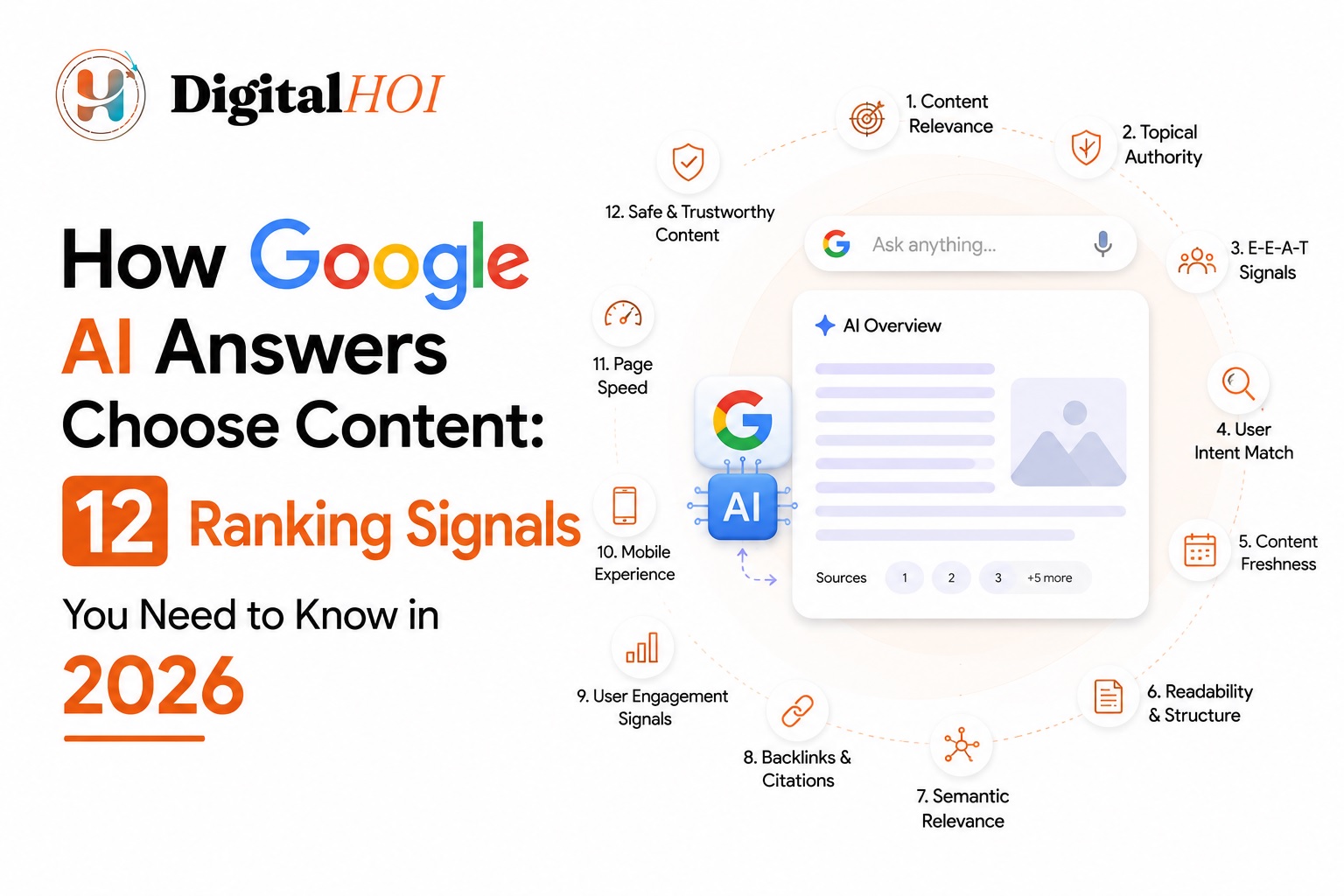
Google Search has entered a new era. Instead of simply displaying a list of blue links, Google now provides AI-generated summaries through AI Overviews (often referred to as Google AI Answers). These summaries aim to answer a user's question directly while linking to trusted sources for further reading.
For businesses, this changes the goal of SEO. Ranking on the first page is still important, but it is no longer the only measure of success. The new objective is to become a trusted source that Google's AI chooses to reference.
So, how does Google AI decide which content to include?
While Google hasn't published a checklist of AI Overview ranking factors, its public guidance and search quality principles indicate that AI-generated answers rely on the same fundamentals that power high-quality search results: relevance, helpfulness, authority, and trust.
In this guide, we'll explore the key signals that can improve your chances of being featured in Google AI Answers.
What Are Google AI Answers?
Google AI Answers are AI-generated summaries that appear at the top of some search results. They combine information from multiple trusted sources to provide a concise answer before users explore individual websites.
Unlike Featured Snippets, which usually extract text from a single webpage, AI Answers synthesize information from multiple sources and may reference several websites.
This means your content needs to be more than keyword-optimized—it needs to be authoritative, well-structured, and genuinely useful.
1. Google Prioritizes Helpful Content
The first and most important signal is content quality.
Google's AI is designed to help users solve problems, not simply match keywords.
Ask yourself:
- Does this article answer the user's question?
- Does it explain the topic clearly?
- Does it provide practical value?
- Would someone bookmark or share it?
Helpful, comprehensive content is far more likely to be referenced than shallow articles created only to target keywords.
DigitalHOI Tip: Focus on solving complete user problems rather than writing around individual keywords.
2. Search Intent Matters More Than Keywords
Traditional SEO often focused on exact-match keywords.
Today, Google AI understands intent.
For example, someone searching:
How can manufacturers automate customer follow-ups?
isn't looking for a definition of CRM. They're looking for a practical solution.
Instead of repeating keywords, structure your content to answer:
- What is it?
- Why does it matter?
- How does it work?
- What are the benefits?
- What are the common mistakes?
- How can someone implement it?
Covering the full journey increases the usefulness of your content.
3. E-E-A-T Is Essential
Google evaluates content using Experience, Expertise, Authoritativeness, and Trustworthiness (E-E-A-T).
Content is more likely to be trusted when it includes:
- Real implementation experience
- Expert authors
- Original insights
- Accurate information
- Supporting examples
- Updated statistics
If your article simply repeats what every other website says, it offers little reason for Google AI to prioritize it.
4. Comprehensive Topic Coverage
Google AI prefers complete resources over fragmented information.
For example, if you're writing about Answer Engine Optimization, don't stop after defining it.
Cover:
- How it works
- Benefits
- Challenges
- Best practices
- Tools
- Real examples
- FAQs
- Common mistakes
This demonstrates topical authority and reduces the need for users to search elsewhere.
5. Clear Content Structure
AI systems process structured information more effectively.
Use:
- Descriptive headings (H2 and H3)
- Numbered steps
- Bullet points
- Tables
- Comparison charts
- Short paragraphs
- Summary sections
Well-organized content is easier for both readers and machines to understand.
6. Direct Answers Improve AI Visibility
One of the key principles of Answer Engine Optimization (AEO) is providing the answer first.
For example:
What Is AI Search Optimization?
AI Search Optimization is the practice of improving your website so that both search engines and AI-powered platforms can understand, trust, and recommend your content.
Then expand with examples, implementation tips, and deeper explanations.
This answer-first format makes it easier for AI systems to identify relevant information.
7. Structured Data Helps Machines Understand Your Website
Schema markup doesn't guarantee inclusion in AI Answers, but it provides valuable context.
Consider implementing:
- Organization Schema
- Article Schema
- FAQ Schema
- Breadcrumb Schema
- Author Schema
- Service Schema
Structured data helps Google interpret your content more accurately and can support richer search experiences.
8. Topical Authority Builds Trust
Publishing one excellent article is helpful.
Publishing an interconnected library of high-quality content is even better.
For example, if your website includes:
- AI Search Optimization Guide
- SEO vs AEO
- What Is GEO?
- Voice Search Optimization
- Google AI Overviews Guide
- Entity SEO
- Schema Markup Guide
Google gains stronger evidence that your website is an authoritative resource on the subject.
This is why topic clusters are so effective.
9. Freshness and Accuracy Matter
AI-generated answers aim to provide current information.
Review your cornerstone content regularly by:
- Updating screenshots
- Refreshing statistics
- Adding new examples
- Removing outdated references
- Expanding sections based on new developments
Content maintenance is an ongoing part of AI Search Optimization.
10. Strong Internal Linking Improves Context
Internal links help Google understand the relationships between your pages.
For example:
Pillar Page
AI Search Optimization Guide
↓
Supporting Articles
- SEO vs AEO
- Voice Search Optimization
- AI Overview Optimization
- Entity SEO
- Knowledge Graph
- Structured Data Guide
This hub-and-spoke architecture strengthens topical authority and improves navigation.
11. Brand Authority Extends Beyond Your Website
Google doesn't evaluate your website in isolation.
It also considers broader trust signals such as:
- Industry mentions
- Customer reviews
- Case studies
- Original research
- Expert interviews
- Consistent branding
A recognized, credible brand is more likely to earn visibility across both traditional search and AI-generated experiences.
12. User Experience Still Matters
Even the best content can underperform if users have a poor experience.
Focus on:
- Fast page speed
- Mobile-friendly design
- Readable typography
- Clear navigation
- Accessible layouts
- Helpful calls to action
Positive engagement signals support long-term search performance and user satisfaction.
Common Mistakes to Avoid
Many businesses reduce their chances of appearing in AI Answers by making avoidable mistakes.
Avoid:
- Writing for search engines instead of people
- Publishing thin, repetitive content
- Ignoring E-E-A-T principles
- Using unclear page structures
- Neglecting internal linking
- Allowing cornerstone content to become outdated
- Relying entirely on AI-generated text without human expertise
Best Practices Checklist
Before publishing, ask:
- Does the article answer the user's main question immediately?
- Is the content comprehensive?
- Have you demonstrated expertise?
- Is the page easy to read?
- Are there helpful internal links?
- Is schema markup implemented?
- Have you included original examples or insights?
- Is the content updated and accurate?
If the answer is "yes" to each question, your content is well-positioned for both search engines and AI-powered search experiences.
Conclusion
Google AI Answers are changing how users discover information, but the core principles of quality remain the same.
Instead of searching for shortcuts, focus on creating content that is:
- Helpful
- Accurate
- Well-structured
- Experience-driven
- Comprehensive
- Trustworthy
Businesses that consistently publish this type of content are better positioned to earn visibility in both Google Search and AI-generated answers.
Remember, the goal isn't simply to rank—it's to become a source that Google trusts enough to recommend.
Frequently Asked Questions
Does Google AI Answers use only one website?
No. AI Answers typically synthesize information from multiple trusted sources to generate a response.
Can schema markup guarantee AI Overview visibility?
No. Schema improves machine understanding but does not guarantee inclusion.
Is traditional SEO still important?
Yes. Technical SEO, quality content, and authority remain the foundation for AI visibility.
How often should I update AI-focused content?
Review cornerstone content every 6–12 months or sooner if there are significant changes in the topic.