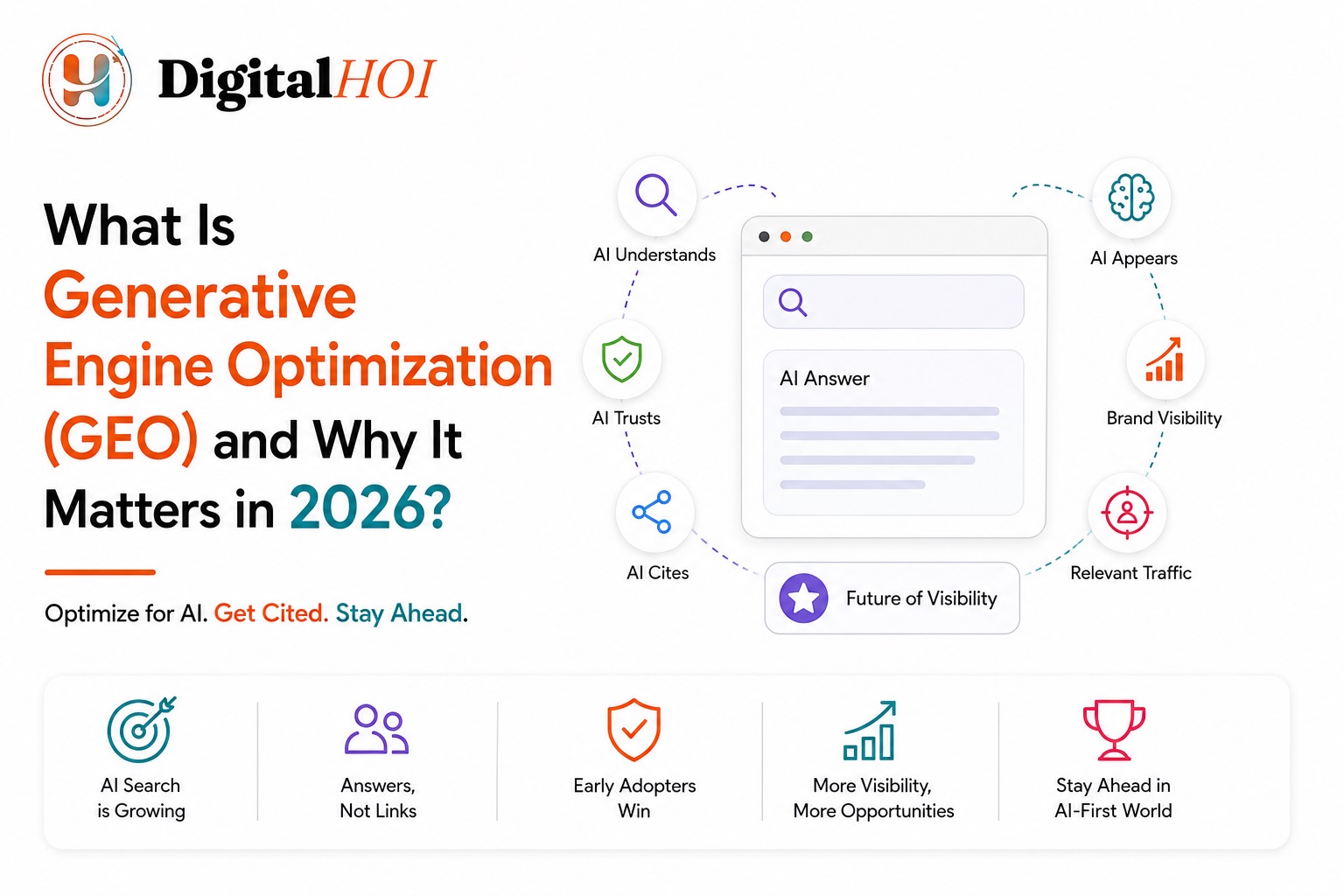
The way people search for information is changing rapidly.
A few years ago, a customer searching for a digital marketing agency would type:
Best SEO Company in India
Today, the same customer is more likely to ask an AI assistant:
Which digital marketing agency in India specializes in AI Search Optimization and Manufacturing SEO?
Instead of returning ten blue links, AI platforms such as Google AI Overviews, ChatGPT, Perplexity, Gemini, and Microsoft Copilot generate a complete answer by combining information from multiple trusted sources.
This shift has introduced a new digital marketing discipline called Generative Engine Optimization (GEO).
If SEO helps users find your website, GEO helps AI recommend your business.
In this guide, you'll learn what GEO is, how it differs from SEO, why it's becoming essential in 2026, and how businesses can build a future-ready AI search strategy.
What Is Generative Engine Optimization (GEO)?
Generative Engine Optimization (GEO) is the process of optimizing your website, content, brand authority, and digital presence so that AI-powered search engines and Large Language Models (LLMs) can understand, trust, and reference your business when generating answers.
Unlike traditional SEO, which focuses on improving rankings in search engine results, GEO focuses on increasing the likelihood of being cited, recommended, or summarized by AI systems.
Think of GEO as SEO for AI-powered search experiences.
Its objective is not only to drive website traffic but also to establish your brand as a trusted source of information.
Why GEO Is Becoming Important in 2026
Search behavior is evolving faster than ever.
Instead of browsing multiple websites, users increasingly rely on AI-generated summaries that provide immediate answers.
This shift creates a new challenge:
If AI answers the question without mentioning your business, your website may never be discovered.
That makes GEO an essential part of modern digital marketing.
Businesses that invest in GEO today are preparing for a future where AI plays a larger role in research, product comparisons, purchasing decisions, and customer support.
How Does Generative AI Choose Information?
One of the biggest misconceptions is that AI simply "copies" content from websites.
In reality, AI systems evaluate multiple signals before generating responses.
Although each platform uses different technologies, they generally look for:
- Relevant and comprehensive information
- Strong topical authority
- Trusted brands
- Clear content structure
- Semantic relationships between topics
- Consistent expertise
- Up-to-date information
- Positive user experience
In other words, AI rewards websites that consistently demonstrate expertise and reliability.
GEO vs Traditional SEO
Although they complement each other, GEO and SEO have different objectives.
| SEO | GEO |
|---|---|
| Improves rankings in search engines | Improves visibility in AI-generated answers |
| Optimizes for search engine crawlers | Optimizes for AI understanding and trust |
| Focuses on keywords | Focuses on topics, entities, and context |
| Measures rankings and traffic | Measures citations, mentions, and AI visibility |
| Relies heavily on backlinks | Values authority, expertise, and brand reputation alongside links |
The most successful businesses will combine both strategies rather than treating them as alternatives.
The Six Pillars of Generative Engine Optimization
1. Topical Authority
AI systems prefer websites that cover a subject comprehensively.
Instead of publishing isolated blog posts, build content clusters around your core expertise.
For example, if your business offers AI Search Optimization services, create interconnected articles covering:
- SEO
- AEO
- GEO
- AI Optimization (AIO)
- Search Experience Optimization (SXO)
- Google AI Overviews
- ChatGPT Optimization
- Entity SEO
- Schema Markup
- AI Search Ranking Factors
Comprehensive coverage demonstrates expertise and increases trust.
2. Experience and Expertise
AI systems increasingly favor content that reflects real-world knowledge.
Strengthen your content by including:
- Original frameworks
- Practical implementation advice
- Client success stories
- Lessons learned
- Industry observations
Avoid simply repeating information available elsewhere.
Unique insights help differentiate your brand.
3. Brand Authority
Generative AI doesn't evaluate only individual webpages.
It also considers your overall digital reputation.
Strong authority signals include:
- Industry recognition
- Customer testimonials
- Original research
- Thought leadership
- Conference participation
- Expert interviews
- Consistent publishing
The stronger your brand authority, the greater your likelihood of being recognized as a reliable source.
4. Structured Content
AI systems process structured information more efficiently.
Improve readability with:
- Clear headings
- Short paragraphs
- Comparison tables
- Step-by-step guides
- Bullet points
- FAQ sections
- Summary boxes
Well-structured content benefits both readers and AI.
5. Entity Optimization
Modern AI understands concepts—not just keywords.
Instead of repeating the same phrase, build relationships between entities.
For example:
AI Search Optimization connects naturally with:
- Artificial Intelligence
- Search Engine Optimization
- Google AI Overviews
- ChatGPT
- Perplexity
- Gemini
- Digital Marketing
- Schema Markup
- Knowledge Graph
- Machine Learning
This semantic context helps AI better understand your expertise.
6. Content Freshness
AI systems aim to provide current information.
Regularly update your content by:
- Refreshing statistics
- Adding new examples
- Expanding sections
- Removing outdated information
- Incorporating recent industry developments
Fresh content builds credibility over time.
Benefits of GEO for Businesses
Investing in GEO offers several long-term advantages.
Increased AI Visibility
Improve the likelihood of appearing in AI-generated answers.
Stronger Brand Authority
Become recognized as an industry expert.
Future-Proof Marketing
Prepare for the continued growth of AI-powered search.
Better User Trust
Helpful, experience-driven content builds confidence among potential customers.
Higher Organic Performance
Many GEO best practices—such as topical authority and quality content—also strengthen traditional SEO.
How to Build a GEO Strategy
A successful GEO strategy begins with strong SEO fundamentals and expands into AI-focused optimization.
Step 1
Perform a technical SEO audit.
Step 2
Create comprehensive pillar pages.
Step 3
Develop topic clusters around your core services.
Step 4
Publish original research and case studies.
Step 5
Use structured data to improve machine understanding.
Step 6
Strengthen internal linking.
Step 7
Maintain consistent branding across all digital channels.
Step 8
Review and update cornerstone content regularly.
Common GEO Mistakes
Many businesses misunderstand what GEO involves.
Avoid these common mistakes.
Treating GEO as a Replacement for SEO
SEO remains the foundation of digital visibility.
Publishing AI-Generated Content Without Human Review
AI can assist with drafting, but original expertise remains essential.
Ignoring Brand Building
Authority extends beyond your website.
Creating Thin Content
Comprehensive, problem-solving content consistently outperforms shallow articles.
Focusing Only on Keywords
Modern AI understands context, relationships, and intent—not just exact-match phrases.
The Future of GEO
Generative AI will continue to reshape how people discover information.
Future trends include:
- More conversational search
- AI-powered shopping assistants
- Personalized search experiences
- Greater emphasis on trusted brands
- Increased use of multimodal search combining text, images, audio, and video
Businesses that establish authority today will be better positioned as AI search continues to evolve.
Final Thoughts
Generative Engine Optimization is not about manipulating AI.
It's about becoming a source that AI systems trust enough to reference.
That requires:
- Strong SEO fundamentals
- High-quality, experience-driven content
- Technical excellence
- Topical authority
- Structured information
- A credible and consistent brand
Rather than asking, "How can I rank in AI?", ask:
"How can I become the most trusted source in my industry?"
That mindset is the foundation of successful GEO.
Frequently Asked Questions
Is GEO replacing SEO?
No. GEO complements SEO by helping AI-powered search engines understand and recommend your content.
Which AI platforms benefit from GEO?
GEO supports visibility across:
- Google AI Overviews
- ChatGPT
- Perplexity
- Microsoft Copilot
- Gemini
- Future AI-powered search platforms
Does GEO require schema markup?
Schema markup is recommended because it improves machine understanding, although it does not guarantee AI citations.
Is GEO suitable for small businesses?
Yes. Any business that publishes helpful, authoritative content can benefit from GEO principles.
How long does GEO take to show results?
Building authority takes time. Businesses should view GEO as a long-term investment alongside SEO and content marketing.