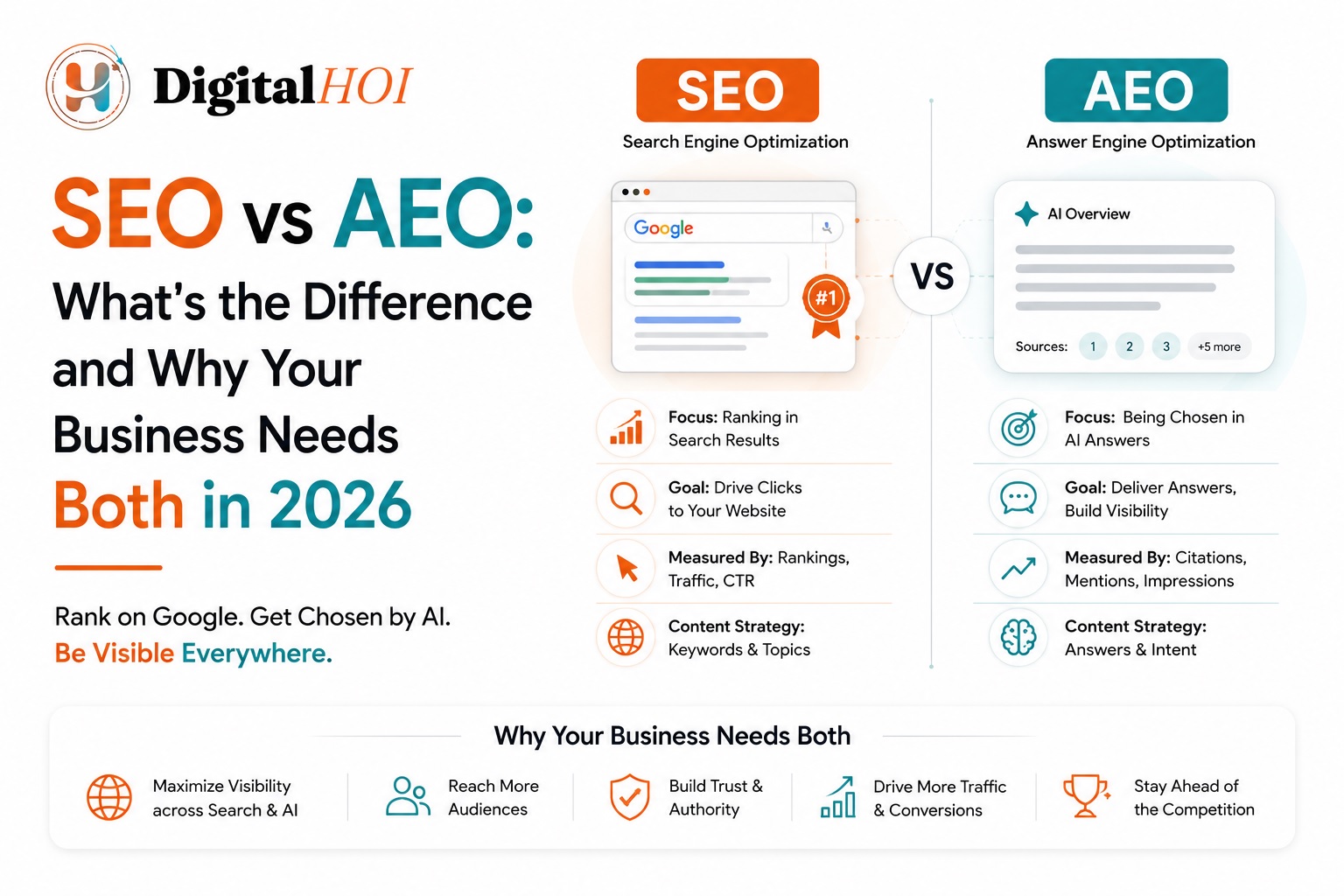
For over two decades, Search Engine Optimization (SEO) has been the foundation of digital marketing. Businesses invested in technical SEO, keyword research, content creation, and backlinks to improve their rankings on Google.
Today, search is evolving. Users are no longer relying solely on traditional search results. They are asking questions directly to Google AI Overviews, ChatGPT, Perplexity, Gemini, Microsoft Copilot, and voice assistants, expecting immediate answers instead of a list of web pages.
This shift has introduced a new discipline called Answer Engine Optimization (AEO).
Many marketers now ask:
Is AEO replacing SEO?
The answer is No.
AEO is not a replacement for SEO—it is an evolution that builds upon a strong SEO foundation.
In this guide, you'll learn the differences between SEO and AEO, how they complement each other, and why businesses should invest in both to succeed in the AI-powered search era.
What Is SEO?
Search Engine Optimization (SEO) is the process of improving a website so that it ranks higher in search engine results pages (SERPs) for relevant keywords.
The primary objective of SEO is to increase organic visibility and drive qualified traffic from search engines like Google and Bing.
A successful SEO strategy typically includes:
- Technical SEO
- Keyword research
- Content optimization
- On-page SEO
- Internal linking
- Link building
- Core Web Vitals optimization
- Mobile usability
- User experience (UX)
SEO helps search engines understand your website and determine when it should appear for relevant searches.
What Is AEO?
Answer Engine Optimization (AEO) is the practice of creating and structuring content so that AI-powered search engines and answer platforms can easily extract and present direct answers to users.
Instead of optimizing only for rankings, AEO optimizes for answer selection.
Platforms that benefit from AEO include:
- Google AI Overviews
- Voice Search
- Google Assistant
- ChatGPT
- Perplexity
- Microsoft Copilot
- Gemini
The goal is simple:
Help AI understand your content well enough to recommend or reference it.
SEO vs AEO: The Core Difference
The easiest way to understand the difference is by looking at the user journey.
Traditional Search
A user searches:
Best CRM Software for Manufacturers
Google displays:
- Website A
- Website B
- Website C
The user chooses which page to visit.
AI Search
The user asks:
Which CRM is best for a manufacturing company with multiple sales teams?
Instead of displaying ten links, AI generates a complete answer using information from several trusted sources.
Your goal is no longer just to rank.
Your goal is to become one of those trusted sources.
SEO vs AEO Comparison Table
| Feature | SEO | AEO |
|---|---|---|
| Primary Goal | Improve search rankings | Get selected as direct answers |
| Focus | Search engines | AI search engines & answer platforms |
| User Journey | Click a webpage | Receive an instant answer |
| Content Style | Comprehensive pages | Answer-first content |
| Keyword Focus | High | Moderate |
| Search Intent | Important | Critical |
| Structured Data | Helpful | Essential |
| FAQ Sections | Recommended | Highly Recommended |
| Voice Search | Limited | Core Focus |
| Google AI Overviews | Supports visibility | Optimized specifically for AI answers |
| Success Metric | Rankings & traffic | AI visibility & answer inclusion |
How SEO and AEO Work Together
One of the biggest misconceptions is that businesses need to choose between SEO and AEO.
The reality is different.
Think of SEO as building the foundation of a house.
AEO is the architecture that makes the house functional and easy to navigate.
Without SEO:
- Your website may not be discovered.
Without AEO:
- AI systems may struggle to understand and use your content.
The best-performing websites combine both strategies.
When Should You Focus on SEO?
SEO should be your priority when your goal is to:
- Increase organic traffic
- Improve keyword rankings
- Build topical authority
- Generate website visitors
- Grow long-term visibility
- Improve technical website health
Every business should invest in SEO because it remains the foundation of digital visibility.
When Should You Focus on AEO?
AEO becomes increasingly important when you want your content to appear in:
- Google AI Overviews
- Featured Snippets
- Voice Search
- AI assistants
- Conversational search platforms
If your audience asks informational questions, AEO can significantly increase your visibility.
Best Practices for SEO
A strong SEO strategy includes:
Technical Excellence
- Fast website
- Mobile responsiveness
- Secure HTTPS
- XML sitemap
- Internal linking
Content Quality
Create:
- Pillar pages
- Topic clusters
- Long-form guides
- Case studies
- Industry insights
Authority Building
Improve:
- Backlinks
- Brand mentions
- Customer reviews
- Expert content
- Original research
Best Practices for AEO
To optimize for answer engines:
Answer Questions Immediately
Start every major section with a concise answer before expanding into detail.
Use Question-Based Headings
Examples:
- What is AEO?
- How does Google AI work?
- Why is AEO important?
Include FAQs
FAQ sections help answer additional user intents and improve content completeness.
Add Comparison Tables
Tables make it easier for AI systems to interpret structured information.
Implement Schema Markup
Use:
- FAQ Schema
- Article Schema
- Organization Schema
- Breadcrumb Schema
- Author Schema
Can AEO Improve SEO?
Yes.
Many AEO best practices also improve traditional SEO.
Examples include:
- Better content structure
- Improved readability
- Stronger search intent alignment
- Enhanced user experience
- Richer semantic content
- Higher engagement
In other words, optimizing for users often benefits both search engines and AI systems.
Common Mistakes Businesses Make
Avoid these common pitfalls:
Believing SEO Is Dead
SEO continues to be the foundation of online visibility.
Writing Only for Keywords
Modern search rewards helpful, user-focused content.
Ignoring Search Intent
Answer the questions users are actually asking—not just the keywords they type.
Publishing Thin Content
Comprehensive resources outperform shallow articles.
Forgetting Internal Linking
Topic clusters strengthen both SEO and AEO by demonstrating topical authority.
The Future of Search
Search is no longer limited to search engines.
Users now interact with AI through:
- Google AI Overviews
- ChatGPT
- Perplexity
- Gemini
- Voice assistants
- AI-powered browsers
Businesses that optimize only for traditional search risk missing these growing opportunities.
The future belongs to organizations that combine:
- SEO
- AEO
- GEO
- AIO
- SXO
into a unified AI Search Optimization strategy.
Final Thoughts
The debate isn't SEO vs AEO.
It's SEO + AEO.
SEO helps people discover your website.
AEO helps AI understand and recommend your content.
Together, they create a stronger digital presence that supports visibility across traditional search engines and emerging AI-powered search experiences.
For businesses looking to remain competitive in 2026 and beyond, integrating SEO and AEO isn't optional—it's a natural evolution of modern search marketing.
Frequently Asked Questions
Is AEO replacing SEO?
No. AEO complements SEO by optimizing content for AI-generated answers rather than replacing traditional search optimization.
Can I rank in Google AI Overviews with SEO alone?
Strong SEO provides the foundation, but AEO techniques such as answer-first writing, structured content, and FAQs can improve your chances of being featured.
Is AEO only for large businesses?
No. Businesses of all sizes can benefit by creating clear, authoritative, and well-structured content that answers user questions.
Does AEO require schema markup?
Schema markup isn't mandatory, but it helps search engines and AI systems better understand your content and is considered a best practice.