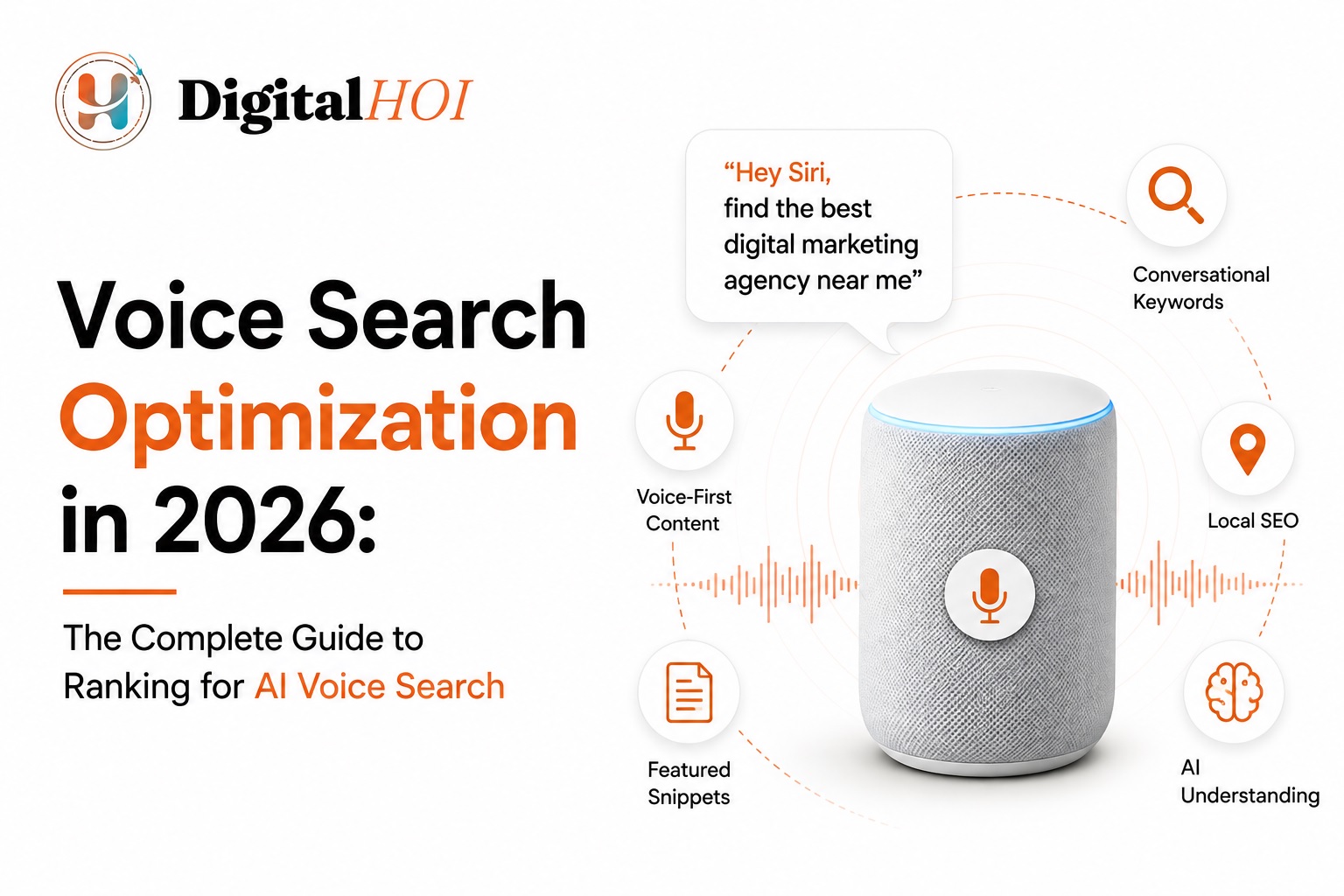
The way people search online is changing faster than ever.
Typing a few keywords into Google is no longer the only way users find information. Millions of people now ask complete questions using Google Assistant, Siri, Alexa, Microsoft Copilot, ChatGPT Voice, Gemini Live, and in-car voice assistants.
Instead of typing:
best CRM software
People now ask:
What is the best CRM software for a manufacturing company with 50 employees?
This shift toward natural, conversational search has made Voice Search Optimization (VSO) an essential part of modern SEO and AI Search Optimization.
If your content isn't optimized for spoken queries, your business may miss valuable opportunities to reach customers who prefer voice-based interactions.
In this guide, you'll learn what Voice Search Optimization is, why it matters in 2026, and how to optimize your website for AI-powered voice search.
What Is Voice Search Optimization?
Voice Search Optimization is the process of optimizing your website, content, and local business information so that voice assistants and AI-powered search engines can understand and deliver your content as spoken answers.
Unlike traditional SEO, which focuses on webpage rankings, Voice Search Optimization focuses on providing concise, accurate, and conversational answers to user questions.
Voice search combines several disciplines:
- Search Engine Optimization (SEO)
- Answer Engine Optimization (AEO)
- Local SEO
- AI Search Optimization
- Structured Data
- User Experience (UX)
Together, these strategies improve your chances of becoming the answer users hear from their devices.
Why Voice Search Matters in 2026
Voice search is no longer limited to smartphones.
Users now interact with AI through:
- Smart speakers
- Mobile phones
- Smart TVs
- Cars
- Wearable devices
- AI assistants
- Smart home devices
- Business productivity tools
As AI assistants become more accurate and conversational, voice search is expected to play a larger role in everyday digital interactions.
Businesses that optimize for voice today are preparing for tomorrow's customer behavior.
How Voice Search Differs from Traditional Search
Traditional search:
CRM Software Manufacturing
Voice search:
What is the best CRM software for a small manufacturing business?
Voice searches are typically:
- Longer
- More conversational
- Question-based
- Intent-focused
- Context-aware
This means businesses need to optimize for natural language rather than isolated keywords.
Voice Search vs Text Search
| Text Search | Voice Search |
|---|---|
| Short keywords | Full questions |
| User scans results | User expects one answer |
| Multiple website options | Usually a single spoken response |
| Keyword-focused | Intent-focused |
| Manual interaction | Conversational interaction |
The goal is no longer simply to rank on Page 1.
The goal is to become the answer.
How Voice Search Works
When someone asks a question, voice assistants typically follow these steps:
- Understand the spoken query.
- Identify the user's intent.
- Retrieve trusted information.
- Generate or select the best answer.
- Read the answer aloud.
This process explains why structured, trustworthy, and concise content performs better.
The 10 Pillars of Voice Search Optimization
1. Focus on Conversational Keywords
People don't speak the way they type.
Instead of targeting:
Voice Search SEO
Target natural questions like:
- What is Voice Search Optimization?
- How does voice search work?
- Why is voice search important for SEO?
These long-tail, conversational queries better match user behavior.
2. Answer Questions Immediately
Every important section should begin with a clear answer.
Example:
What Is Voice Search Optimization?
Voice Search Optimization is the process of improving website content so AI assistants and voice-enabled devices can understand and deliver accurate spoken answers to user questions.
Then expand with details.
This "answer-first" approach supports Answer Engine Optimization and voice assistants alike.
3. Optimize for Featured Snippets
Many voice assistants use concise summaries that resemble Featured Snippets or AI-generated answers.
Improve your chances by including:
- Definitions
- Lists
- Tables
- Step-by-step instructions
- FAQ sections
These formats are easy for machines to interpret and present.
4. Build Strong Local SEO
A large percentage of voice searches have local intent.
Examples include:
- SEO company near me
- Best digital marketing agency in Ambala
- Website designer near me
To improve local voice visibility:
- Optimize your Google Business Profile.
- Keep your business information consistent.
- Encourage customer reviews.
- Create location-specific content.
- Add LocalBusiness schema where appropriate.
5. Improve Page Speed
Voice users expect fast answers.
A slow website may reduce engagement and negatively affect overall search performance.
Focus on:
- Core Web Vitals
- Image optimization
- Efficient code
- Mobile performance
Fast websites provide better user experiences across all search channels.
6. Use Structured Data
Schema markup helps search engines understand your content.
Recommended schema includes:
- FAQ Schema
- Organization Schema
- Article Schema
- Breadcrumb Schema
- Author Schema
- LocalBusiness Schema
- Service Schema
Structured data supports machine understanding, although it does not guarantee voice selection.
7. Create FAQ Sections
Voice searches often begin with:
- What
- Why
- How
- When
- Where
- Who
Adding FAQ sections allows you to answer these questions directly and naturally.
8. Strengthen E-E-A-T
Voice assistants prioritize trustworthy information.
Build credibility through:
- Expert authors
- Case studies
- Original research
- Updated content
- Transparent business information
- Customer testimonials
Trust remains a core signal for both search engines and AI systems.
9. Optimize for Mobile Users
Most voice searches happen on mobile devices.
Ensure your website offers:
- Responsive design
- Easy navigation
- Readable typography
- Click-friendly buttons
- Accessible forms
A positive mobile experience supports both SEO and user satisfaction.
10. Create Comprehensive Topic Clusters
Instead of publishing isolated articles, develop interconnected content around voice search.
Example cluster:
Pillar
AI Search Optimization
↓
Supporting Articles
- Voice Search Optimization
- SEO vs AEO
- Google AI Overviews Guide
- Featured Snippets vs AI Answers
- Entity SEO
- Schema Markup Guide
- Conversational Search
- AI Search Ranking Factors
This structure strengthens topical authority and helps search engines understand your expertise.
Voice Search and AI Search: What's the Connection?
Voice search is becoming increasingly powered by AI.
Modern assistants don't simply retrieve webpages—they interpret intent, understand context, and generate conversational responses.
That means Voice Search Optimization now overlaps with:
- AI Search Optimization
- Answer Engine Optimization
- Generative Engine Optimization
- Conversational AI
Businesses should think beyond "voice SEO" and optimize for the broader AI search ecosystem.
Common Voice Search Mistakes
Avoid these common errors:
Writing only for keywords
Natural language matters more than keyword repetition.
Ignoring local SEO
Many voice searches involve nearby businesses and services.
Publishing thin content
Comprehensive, user-focused content performs better than short, generic articles.
Forgetting structured data
Schema helps machines interpret your content more effectively.
Ignoring mobile experience
A poor mobile experience undermines both voice and traditional search performance.
Voice Search Optimization Checklist
Before publishing, ask:
- Does the article answer questions directly?
- Is the content conversational?
- Have you included FAQs?
- Is the website mobile-friendly?
- Is page speed optimized?
- Is schema markup implemented?
- Are local SEO elements in place?
- Have you linked related articles?
If the answer is yes, you're building a strong foundation for voice search.
The Future of Voice Search
Voice search is evolving beyond smart speakers.
Future developments include:
- AI-powered voice conversations
- Personalized voice assistants
- Multimodal interactions combining voice, text, and images
- Voice commerce
- Industry-specific AI assistants
- Hands-free workplace productivity
Businesses that prepare today will be better positioned as conversational AI becomes more deeply integrated into everyday life.
Final Thoughts
Voice Search Optimization is no longer an optional SEO tactic.
It is an essential component of AI Search Optimization.
The businesses that succeed in 2026 will create content that is:
- Conversational
- Helpful
- Structured
- Trustworthy
- Experience-driven
- Easy for AI to understand
Rather than optimizing only for rankings, optimize to become the answer users hear when they ask their next question.
Frequently Asked Questions
Is Voice Search Optimization different from SEO?
Yes. Voice Search Optimization builds on SEO by focusing on conversational queries, direct answers, and spoken search experiences.
Does voice search still matter in 2026?
Yes. As AI assistants become more capable across phones, cars, wearables, and business tools, voice interactions continue to grow in importance.
Does schema markup improve voice search?
Schema helps search engines understand your content more effectively, making it a recommended best practice, although it does not guarantee voice search selection.
Is Voice Search Optimization important for local businesses?
Absolutely. Many voice searches have local intent, making Local SEO, accurate business information, and customer reviews especially valuable.