Key Takeaways
-
Shopify and WooCommerce are both capable ecommerce platforms with strong SEO potential.
-
Shopify offers simplicity, managed hosting, and beginner-friendly SEO features.
-
WooCommerce provides greater flexibility, customization, and content marketing capabilities.
-
WooCommerce generally offers more advanced SEO control and technical customization.
-
Shopify is often easier to manage for businesses with limited technical resources.
-
Content quality, technical optimization, and user experience matter more than platform choice alone.
-
The best platform depends on your business goals, technical expertise, and growth strategy.
Choosing the right ecommerce platform is one of the most important decisions for any online business. While design, functionality, and ease of use are critical considerations, search engine optimization (SEO) should also play a major role in the decision-making process.
Two of the most popular ecommerce platforms today are Shopify and WooCommerce. Both power millions of online stores worldwide and offer robust ecommerce capabilities.
However, when it comes to SEO, each platform has its own strengths, limitations, and optimization opportunities.
The question many business owners ask is:
Which platform is better for SEO—Shopify or WooCommerce?
The answer depends on your business goals, technical expertise, scalability requirements, and long-term growth strategy.
In this guide, we'll compare Shopify SEO and WooCommerce SEO across key ranking factors to help you make an informed decision.
Understanding Shopify and WooCommerce
Before comparing SEO capabilities, it's important to understand how these platforms differ.
What is Shopify?
Shopify is a hosted ecommerce platform that provides everything needed to build and manage an online store.
Features include:
-
Web hosting
-
Security
-
Ecommerce functionality
-
Payment integration
-
App marketplace
-
Website management tools
Shopify is known for its simplicity and ease of use.
What is WooCommerce?
WooCommerce is an ecommerce plugin built for WordPress.
It transforms a WordPress website into a fully functional online store.
WooCommerce offers:
-
Complete customization
-
Flexible design options
-
Extensive plugin ecosystem
-
Full website control
Unlike Shopify, WooCommerce requires separate hosting and technical management.
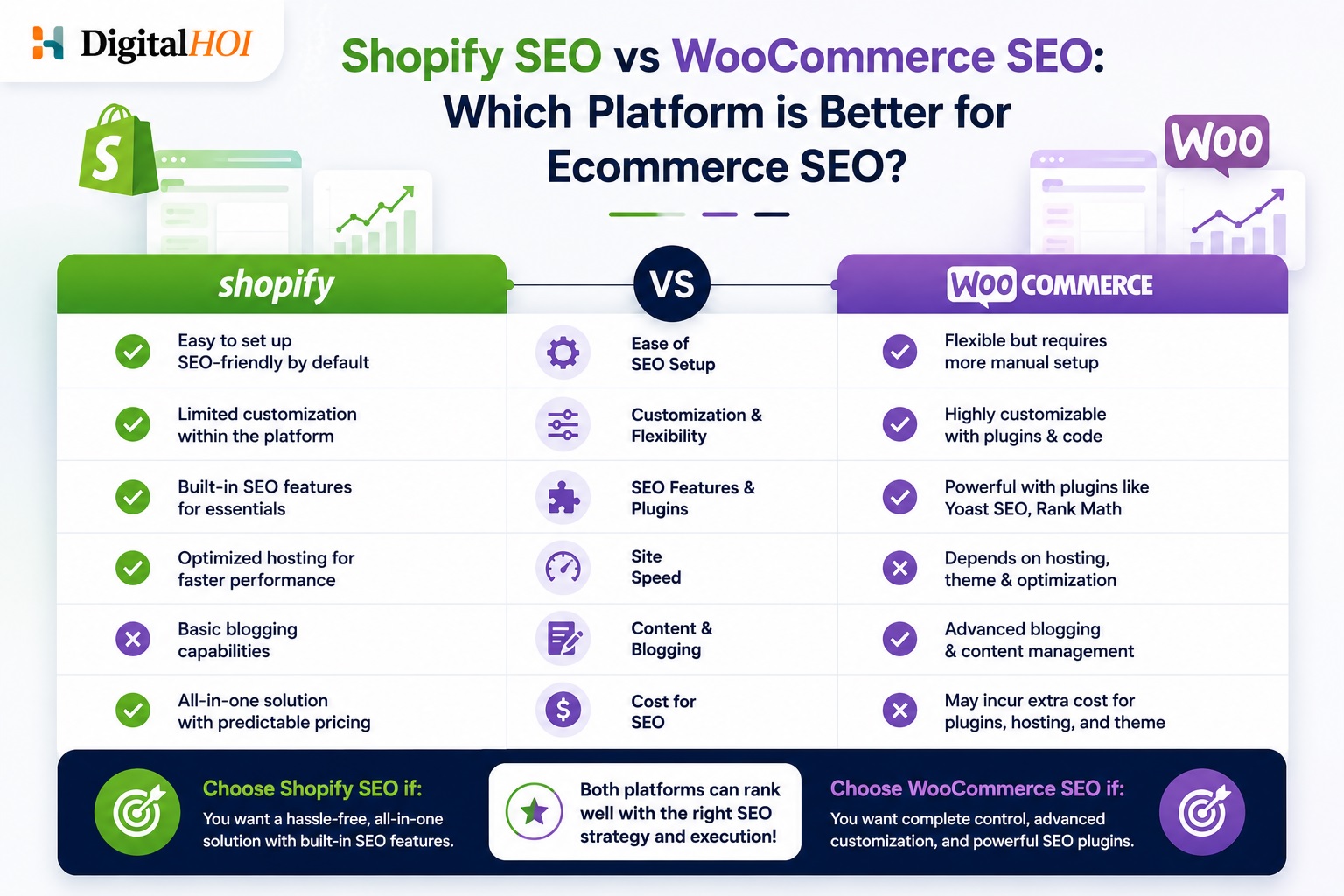
Shopify SEO vs WooCommerce SEO: Overview
|
SEO Factor |
Shopify |
WooCommerce |
|
Ease of SEO Setup |
Excellent |
Good |
|
Technical Flexibility |
Limited |
Excellent |
|
URL Customization |
Moderate |
Excellent |
|
Content Marketing |
Good |
Excellent |
|
Site Speed Control |
Limited |
Excellent |
|
Plugin Availability |
Good |
Excellent |
|
Schema Customization |
Moderate |
Excellent |
|
Scalability |
Excellent |
Excellent |
|
Beginner Friendliness |
Excellent |
Moderate |
|
Advanced SEO Control |
Moderate |
Excellent |
Both platforms can rank well in search engines when properly optimized.
The difference lies in the level of control and customization available.
Shopify SEO Advantages
1. Easy SEO Setup
One of Shopify's biggest strengths is simplicity.
SEO settings are easy to configure without technical expertise.
Store owners can quickly manage:
-
Page titles
-
Meta descriptions
-
URLs
-
Redirects
-
Image alt text
This makes Shopify attractive for businesses without dedicated development resources.
2. Fast and Reliable Hosting
Shopify includes managed hosting.
Benefits include:
-
High uptime
-
Security management
-
Automatic updates
-
Reliable infrastructure
Since website performance influences SEO, Shopify's hosting environment provides a strong foundation.
3. Mobile-Friendly by Default
Most Shopify themes are designed with mobile responsiveness in mind.
Mobile optimization supports:
-
Better user experience
-
Improved rankings
-
Higher conversion rates
Given Google's mobile-first indexing approach, this is a significant advantage.
4. Built-In Technical SEO Features
Shopify automatically handles several technical SEO elements.
These include:
-
SSL certificates
-
XML sitemaps
-
Canonical tags
-
Secure hosting
This reduces technical complexity for store owners.
Shopify SEO Limitations
Despite its strengths, Shopify has some SEO restrictions.
URL Structure Limitations
Shopify automatically inserts folders into URLs.
Examples:
/products/
/collections/
Store owners cannot completely customize these structures.
Limited Server Control
Because Shopify is a hosted platform, users cannot modify server-level settings.
Advanced SEO customizations may be restricted.
Dependence on Apps
Many advanced SEO features require third-party apps, which can increase costs.
WooCommerce SEO Advantages
1. Complete SEO Control
WooCommerce offers greater flexibility than Shopify.
Businesses can customize:
-
URLs
-
Website structure
-
Metadata
-
Schema markup
-
Technical SEO settings
This level of control appeals to SEO-focused businesses.
2. WordPress Content Marketing Power
Content marketing is often critical for Ecommerce SEO success.
WooCommerce benefits from WordPress's powerful content management system.
Businesses can easily create:
-
Blogs
-
Guides
-
Resource centers
-
Topic clusters
-
Landing pages
This makes WooCommerce particularly attractive for content-driven SEO strategies.
3. Advanced SEO Plugins
WooCommerce users have access to powerful SEO plugins such as:
-
Rank Math
-
Yoast SEO
-
All in One SEO
These tools provide advanced optimization capabilities.
4. Full URL Customization
Unlike Shopify, WooCommerce allows complete control over URL structures.
SEO-friendly URLs can improve:
-
User experience
-
Crawlability
-
Keyword relevance
5. Greater Technical Flexibility
WooCommerce allows businesses to customize:
-
Hosting environments
-
Caching systems
-
Performance settings
-
Server configurations
This flexibility can create significant SEO advantages when managed properly.
WooCommerce SEO Challenges
Technical Complexity
WooCommerce requires more setup and maintenance.
Store owners often need assistance with:
-
Hosting
-
Security
-
Updates
-
Performance optimization
Performance Depends on Hosting
SEO performance can vary significantly depending on hosting quality.
Poor hosting can negatively affect:
-
Site speed
-
Reliability
-
User experience
More Maintenance Responsibilities
Unlike Shopify, WooCommerce users manage:
-
Backups
-
Security
-
Plugin updates
-
Technical troubleshooting
This increases operational responsibilities.
Comparing Key Ecommerce SEO Factors
Content Marketing
Shopify
Good for blogging but limited compared to WordPress.
WooCommerce
Excellent content publishing capabilities.
Winner: WooCommerce
Technical SEO
Shopify
Strong built-in SEO features.
WooCommerce
Greater flexibility and customization.
Winner: WooCommerce
Ease of Use
Shopify
Very beginner-friendly.
WooCommerce
Requires more technical knowledge.
Winner: Shopify
Site Performance
Shopify
Reliable performance with managed hosting.
WooCommerce
Can outperform Shopify with proper optimization.
Winner: Tie
Scalability
Both platforms can support growing ecommerce businesses.
Winner: Tie
SEO Customization
Shopify
Moderate customization.
WooCommerce
Extensive customization options.
Winner: WooCommerce
Which Platform is Better for Ecommerce SEO?
The answer depends on your business requirements.
Choose Shopify If:
✔ You want a simple solution
✔ You have limited technical expertise
✔ You prefer managed hosting
✔ You want faster deployment
✔ You need minimal maintenance
Shopify is ideal for businesses prioritizing convenience and operational simplicity.
Choose WooCommerce If:
✔ SEO is a major growth channel
✔ You want maximum flexibility
✔ You plan to invest heavily in content marketing
✔ You need advanced customization
✔ You have access to technical support
WooCommerce is often the preferred choice for businesses pursuing aggressive long-term SEO growth.
Can Both Platforms Rank on Google?
Absolutely.
Search engines do not favor Shopify or WooCommerce directly.
Google primarily evaluates:
-
Content quality
-
User experience
-
Technical performance
-
Relevance
-
Authority
A well-optimized Shopify store can outperform a poorly optimized WooCommerce website, and vice versa.
SEO success ultimately depends on strategy and execution rather than platform selection alone.
Common SEO Mistakes on Both Platforms
Avoid these common issues:
❌ Duplicate product descriptions
❌ Thin category pages
❌ Poor internal linking
❌ Slow page speed
❌ Weak content strategy
❌ Missing schema markup
❌ Poor mobile experience
❌ Ignoring keyword research
These mistakes can limit performance regardless of platform choice.
Need Help Optimizing Your Ecommerce Store?
Whether your online store is built on Shopify, WooCommerce, Magento, or another ecommerce platform, a strategic SEO approach is essential for long-term growth.
At DigitalHOI, our Ecommerce SEO Services help businesses improve product rankings, increase organic traffic, optimize technical performance, and generate more online sales.
From technical audits and keyword research to content marketing and conversion optimization, we help ecommerce brands build sustainable organic growth.