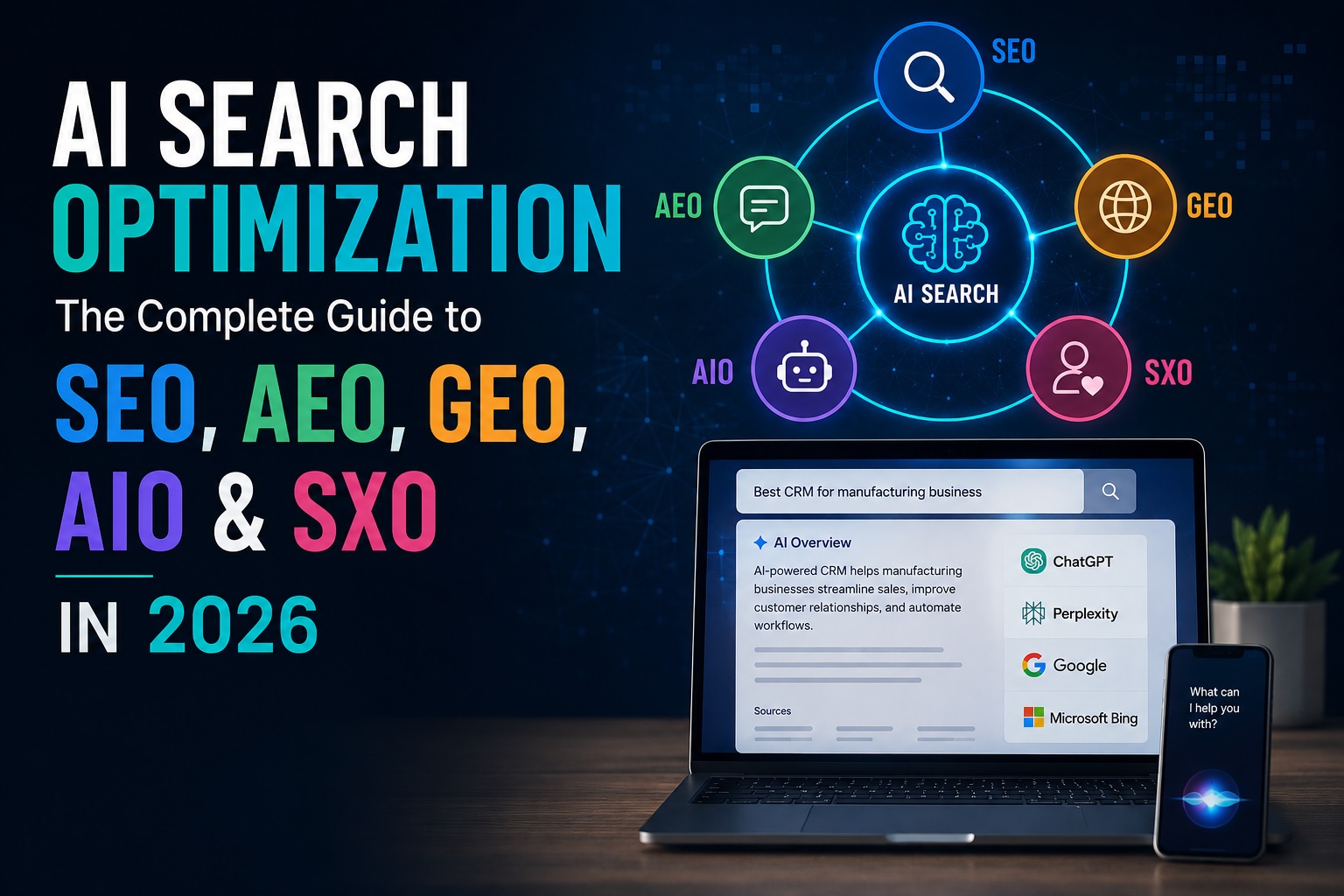
Traditional SEO is no longer enough.
People still search Google—but they're increasingly getting answers from AI systems like ChatGPT, Google AI Overviews, Perplexity, Microsoft Copilot, and Gemini. Instead of clicking through ten blue links, users are asking complex questions and expecting direct, trustworthy answers.
This shift is changing how businesses earn visibility online.
For years, ranking #1 on Google was the primary objective of digital marketing. Today, success means something broader:
-
Appearing in Google Search results
-
Being cited in AI-generated answers
-
Becoming a trusted source for conversational AI
-
Delivering an exceptional on-site experience that converts visitors into customers
That requires more than traditional SEO. It requires a modern strategy that combines:
-
SEO (Search Engine Optimization) to improve discoverability in search engines.
-
AEO (Answer Engine Optimization) to structure content that AI systems can extract as direct answers.
-
GEO (Generative Engine Optimization) to increase the likelihood that generative AI platforms cite your brand.
-
AIO (AI Optimization) to make your website and content AI-ready across search, assistants, and emerging AI interfaces.
-
SXO (Search Experience Optimization) to ensure users have a fast, intuitive, and conversion-focused experience once they arrive.
Together, these disciplines form what we call AI Search Optimization—a holistic approach to building visibility across both traditional search engines and AI-powered discovery platforms.
This guide is designed for business owners, marketers, SEO professionals, and decision-makers who want to future-proof their digital presence. By the end, you'll understand not only what each discipline means but also how they work together to drive sustainable organic growth.
Why Search Has Changed Forever
Search has undergone several major transformations over the past three decades.
Era 1: Keyword Search (1998–2012)
The early web was dominated by keyword matching. Success depended on repeating target phrases throughout a webpage, often with little regard for user experience or content quality.
Common ranking tactics included:
-
Keyword stuffing
-
Exact-match domains
-
Large-scale directory submissions
-
Mass backlink acquisition
While effective at the time, these methods often prioritized algorithms over users.
Era 2: Semantic Search (2013–2022)
Search engines became significantly more sophisticated. Google's updates introduced an emphasis on understanding context, user intent, and content quality.
Key developments included:
-
Natural language processing
-
Entity recognition
-
Knowledge Graph
-
E-E-A-T (Experience, Expertise, Authoritativeness, Trustworthiness)
-
Helpful Content systems
Content that genuinely solved user problems began outperforming pages created solely for search engines.
Era 3: AI Search (2023–Present)
The introduction of large language models fundamentally changed how users discover information.
Instead of typing fragmented keywords like:
best CRM manufacturing India
Users now ask complete questions such as:
What CRM is best for a mid-sized manufacturing company with a remote sales team?
AI systems synthesize information from multiple trusted sources to generate comprehensive answers. Visibility now depends not only on ranking but also on being recognized as a credible source worthy of citation.
This is where Answer Engine Optimization, Generative Engine Optimization, AI Optimization, and Search Experience Optimization become essential.
The New Search Ecosystem
Think of modern search as a connected ecosystem rather than separate channels.
|
Platform |
Primary Goal |
Optimization Focus |
|
Google Search |
Rank web pages |
SEO |
|
Google AI Overviews |
Generate summaries |
SEO + AEO + GEO |
|
ChatGPT |
Conversational answers |
GEO + AIO |
|
Perplexity |
AI answers with citations |
GEO + AEO |
|
Microsoft Copilot |
AI-assisted search |
GEO |
|
Gemini |
AI knowledge assistance |
GEO + AIO |
|
Voice Assistants |
Direct spoken answers |
AEO |
|
Your Website |
Convert visitors |
SXO |
The businesses that succeed in 2026 will optimize for this entire ecosystem rather than treating each platform independently.
What Is Search Engine Optimization (SEO)?
Search Engine Optimization (SEO) is the process of improving a website's visibility in organic search results by making it more relevant, authoritative, technically accessible, and valuable to users.
While SEO has evolved significantly, its core objective remains the same:
Help search engines understand your content so they can confidently recommend it to the right audience.
Modern SEO is no longer about manipulating rankings. It's about building trust.
A strong SEO strategy combines technical excellence, high-quality content, topical authority, and a positive user experience.
The Four Pillars of Modern SEO
1. Technical SEO
Technical SEO ensures search engines can crawl, understand, and index your website efficiently.
This includes:
-
Site architecture
-
XML sitemaps
-
Robots.txt
-
Canonical tags
-
Structured data
-
Page speed
-
Core Web Vitals
-
Mobile responsiveness
-
HTTPS security
Without a solid technical foundation, even exceptional content may struggle to perform.
2. Content SEO
Content is how your business demonstrates expertise.
Effective content:
-
Solves genuine user problems
-
Covers topics comprehensively
-
Answers related questions
-
Uses semantic language
-
Incorporates relevant entities
-
Builds topical authority over time
Rather than targeting isolated keywords, successful websites create interconnected content hubs that thoroughly address a subject.
3. Authority SEO
Search engines assess whether your website is trusted by others.
Authority signals include:
-
High-quality backlinks
-
Brand mentions
-
Industry citations
-
Expert authorship
-
Customer reviews
-
Media coverage
As AI search becomes more prevalent, unlinked brand mentions and recognized expertise are increasingly important alongside traditional backlinks.
4. User Experience
Google rewards websites that provide a satisfying experience.
This includes:
-
Fast loading pages
-
Clear navigation
-
Readable content
-
Mobile usability
-
Helpful design
-
Strong engagement
-
Low friction
User experience is no longer separate from SEO—it is an integral ranking factor.
What SEO Alone Can—and Cannot—Do
SEO remains the foundation of digital visibility, but it is no longer sufficient on its own.
SEO excels at:
-
Ranking web pages
-
Driving organic traffic
-
Building topical authority
-
Improving website discoverability
However, SEO alone does not guarantee:
-
Inclusion in AI-generated answers
-
Citations by ChatGPT or Perplexity
-
Visibility in conversational search
-
Optimization for voice assistants
These newer challenges require additional strategies layered on top of traditional SEO.
What Is Answer Engine Optimization (AEO)?
Answer Engine Optimization (AEO) is the practice of creating and structuring content so that search engines, AI assistants, and voice platforms can extract and present it as a direct answer to a user's question.
Unlike traditional SEO, which aims to rank an entire page, AEO focuses on making specific answers easy to identify, understand, and trust.
Imagine a user asks:
"How can a manufacturing company reduce manual data entry?"
A traditional search engine may return a list of webpages.
An AI-powered answer engine is more likely to present a concise response synthesized from trusted sources, often highlighting only a few references.
Your objective is to become one of those references.
Where AEO Matters
Answer Engine Optimization supports visibility across:
-
Google AI Overviews
-
Featured Snippets
-
Voice assistants
-
Smart speakers
-
AI-powered search interfaces
-
FAQ-rich results
-
Conversational search tools
These systems prioritize content that is structured, authoritative, and directly responsive to user intent.
Characteristics of AEO-Optimized Content
Content designed for answer engines typically includes:
-
Clear question-based headings
-
Concise introductory answers
-
Supporting explanations
-
Lists and step-by-step instructions
-
Definitions
-
Tables and comparisons
-
FAQ sections
-
Appropriate schema markup
-
Accurate, up-to-date information
This structure helps both users and AI systems quickly identify the most relevant information.
Example: SEO vs AEO
The difference between SEO vs AEO: suppose you're writing about CRM automation.
A conventional SEO article might begin with a lengthy introduction before addressing the topic.
An AEO-focused article starts by immediately answering the user's question:
What is CRM Automation?
CRM automation is the use of software and AI to automate repetitive sales, marketing, and customer service tasks such as lead assignment, follow-ups, email sequences, and reporting. It helps businesses improve efficiency, reduce manual work, and deliver a better customer experience.
The article then expands with benefits, examples, implementation steps, and related insights.
This "answer-first" approach increases the likelihood of being surfaced in AI-generated responses.
Why AEO Is Becoming Essential
As search behavior shifts toward conversational queries, users expect immediate, trustworthy answers rather than a list of links.
Businesses that structure their content for answer engines can benefit from:
-
Increased visibility in AI summaries
-
Higher trust and perceived authority
-
Greater exposure for informational queries
-
Enhanced voice search performance
-
Stronger alignment with evolving search behavior
Importantly, AEO does not replace SEO—it builds upon it. A well-optimized website still needs strong technical SEO, authoritative content, and a solid user experience to earn trust.
What Is Generative Engine Optimization (GEO)?
Imagine a potential customer asks ChatGPT:
"Which digital marketing agencies in India specialize in AI automation for manufacturing companies?"
The AI doesn't simply retrieve one webpage. Instead, it analyzes information from multiple trusted sources and generates a response that may mention only a handful of companies.
The question is no longer:
"Can I rank #1 on Google?"
The new question is:
"Will AI systems trust my website enough to cite it?"
This is the purpose of Generative Engine Optimization (GEO).
Definition
Generative Engine Optimization (GEO) is the process of optimizing your website, brand, content, and digital authority so that AI-powered search engines and large language models (LLMs) recognize your expertise and are more likely to reference your information in generated answers.
Unlike SEO, which primarily targets search engine rankings, GEO focuses on increasing your visibility within AI-generated responses.
How Generative AI Finds Information
Many people assume ChatGPT "searches Google." That's an oversimplification.
Depending on the platform and configuration, AI systems may use a combination of:
-
Publicly available web content
-
Search engine indexes
-
Knowledge graphs
-
Structured data
-
High-authority websites
-
Publisher partnerships
-
Recent web search (for models with browsing capabilities)
-
Brand reputation and recurring mentions across trusted sources
This means ranking well is helpful—but it's not the only factor.
AI systems evaluate signals of trust, consistency, expertise, and authority across the broader web.
GEO Is About Building Digital Trust
Think of GEO as reputation management for AI.
You're not optimizing for an algorithm that counts keywords.
You're optimizing for an AI system that asks questions such as:
-
Is this information accurate?
-
Does this website consistently publish quality content?
-
Is the author credible?
-
Do other trusted websites reference this brand?
-
Is the information well structured?
-
Is it current?
-
Is it supported by evidence?
The stronger these trust signals, the greater your chances of being cited.
The Six Pillars of GEO
1. Topical Authority
Publish comprehensive content covering an entire subject—not just isolated keywords.
For example, instead of writing one article on Manufacturing Automation, create an interconnected content hub covering:
-
AI Automation
-
CRM Automation
-
Workflow Automation
-
Inventory Automation
-
Supply Chain Automation
-
ERP Integration
-
Predictive Maintenance
-
Factory Analytics
AI systems are more likely to trust websites demonstrating depth of expertise.
2. Entity Optimization
AI understands entities better than keywords.
Examples include:
-
Companies
-
Products
-
Services
-
Industries
-
Technologies
-
People
-
Locations
Instead of repeatedly inserting the phrase AI Automation Company, build contextual relationships around entities such as:
-
Manufacturing
-
Artificial Intelligence
-
CRM
-
ERP
-
Digital Transformation
-
Predictive Analytics
-
Industrial IoT
This helps AI understand your expertise beyond exact-match phrases.
3. Brand Authority
Brands increasingly matter.
AI is more likely to reference organizations that demonstrate authority through:
-
Industry research
-
Original insights
-
Case studies
-
Expert interviews
-
Conference participation
-
Customer success stories
-
Media mentions
The stronger your brand ecosystem, the more likely AI systems are to recognize and trust it.
4. Structured Content
Generative AI prefers content that is easy to interpret.
Use:
-
Clear headings
-
Numbered lists
-
Comparison tables
-
Definitions
-
FAQs
-
Process diagrams
-
Summary boxes
Well-structured information improves machine readability and user experience.
5. Credibility Signals
Support your claims with:
-
Original data
-
Research
-
Statistics
-
Examples
-
Real-world experience
-
Expert commentary
Pages that demonstrate evidence and expertise are more likely to be cited.
6. Consistency
Authority isn't built through one article.
It develops when your website consistently publishes high-quality content over time.
Consistency signals reliability—a key trait for AI systems selecting trustworthy sources.
GEO vs Traditional SEO
|
SEO |
GEO |
|
Optimizes for search rankings |
Optimizes for AI citations |
|
Focuses on keywords |
Focuses on topics and entities |
|
Backlinks are critical |
Trust signals are equally important |
|
Measures rankings |
Measures citations and mentions |
|
Search engine focused |
AI engine focused |
|
Page-level optimization |
Brand-level optimization |
SEO gets users to your website.
GEO helps AI recommend your brand before users even visit your website.
What Is AI Optimization (AIO)?
One of the biggest misconceptions in digital marketing is that AIO simply means "optimizing content for ChatGPT."
At DigitalHOI, we define AI Optimization (AIO) more broadly.
AI Optimization is the practice of making your entire digital presence understandable, accessible, and valuable to AI systems across search, content discovery, automation, and intelligent assistants.
In other words:
SEO optimizes for search engines.
AEO optimizes for answer engines.
GEO optimizes for generative AI.
AIO optimizes your entire business for the AI ecosystem.
Why AIO Matters
Over the next five years, AI will influence nearly every customer interaction:
-
Search
-
Shopping
-
Customer support
-
Product recommendations
-
Business software
-
Marketing automation
-
Voice interfaces
-
Autonomous AI agents
Businesses that prepare now will have a competitive advantage.
The Five Layers of AI Optimization
Layer 1 — AI-Ready Website
Your website should be:
-
Fast
-
Crawlable
-
Mobile-friendly
-
Secure
-
Semantically structured
Without this foundation, AI systems may struggle to interpret your content.
Layer 2 — AI-Friendly Content
Content should include:
-
Clear explanations
-
Logical organization
-
Semantic relationships
-
Contextual depth
-
Structured data
-
Visual support
Rather than writing for keywords alone, write to teach both humans and machines.
Layer 3 — AI Data Optimization
This includes:
-
Schema markup
-
Organization data
-
Product data
-
FAQ schema
-
Author schema
-
Knowledge graph optimization
Structured data provides explicit context that AI systems can use to understand your content more accurately.
Layer 4 — AI Authority
Authority extends beyond backlinks.
AI evaluates:
-
Brand mentions
-
Expert profiles
-
Industry recognition
-
Publications
-
Reviews
-
Case studies
-
Original research
The more credible your organization appears across the web, the stronger your AI visibility.
Layer 5 — AI Monitoring
Optimization is an ongoing process.
Track:
-
AI citations
-
Brand mentions
-
Organic visibility
-
AI referral traffic
-
Search performance
-
User engagement
Continuous monitoring helps identify new opportunities and emerging trends.
What Is Search Experience Optimization (SXO)?
Imagine two websites rank for the same keyword.
One loads slowly, has confusing navigation, and makes it difficult to find information.
The other is fast, intuitive, and guides visitors naturally toward their goals.
Which one is more likely to earn trust, engagement, and conversions?
That's where Search Experience Optimization (SXO) comes in.
Definition
SXO combines SEO, User Experience (UX), and Conversion Rate Optimization (CRO) to ensure visitors not only find your website but also have a satisfying experience that encourages meaningful actions.
Ranking is only the beginning. The real objective is to help users accomplish what they came to do.
The Three Pillars of SXO
1. Findability
Can users easily discover your content?
Focus on:
-
SEO
-
Site structure
-
Internal linking
-
Navigation
-
Search intent alignment
2. Usability
Can users quickly understand and interact with your content?
Optimize:
-
Mobile responsiveness
-
Readability
-
Accessibility
-
Page speed
-
Visual hierarchy
3. Conversion
Does your website encourage visitors to take the next step?
Examples include:
-
Contact forms
-
Quote requests
-
Demo bookings
-
Newsletter sign-ups
-
Product purchases
-
Resource downloads
Traffic without conversions delivers limited business value.
Introducing the DigitalHOI AI Visibility Framework™
Most agencies treat SEO, AEO, GEO, AIO, and SXO as separate services.
At DigitalHOI, we believe they are stages of a unified strategy.
The DigitalHOI AI Visibility Framework™
Stage 1 — Discover
Make your website visible in search engines through strong technical SEO and comprehensive content.
Primary Focus: SEO
Stage 2 — Understand
Structure your content so AI systems can identify and extract clear, accurate answers.
Primary Focus: AEO
Stage 3 — Trust
Build authority through expertise, original research, brand recognition, and consistent topical coverage.
Primary Focus: GEO
Stage 4 — Recommend
Strengthen your AI readiness so search engines, AI assistants, and future AI agents are more likely to surface your content.
Primary Focus: AIO
Stage 5 — Convert
Deliver exceptional user experiences that transform visibility into business growth.
Primary Focus: SXO
Key Takeaway
These five disciplines are not competing strategies—they are complementary layers of a modern digital marketing approach.
-
SEO helps users find you.
-
AEO helps AI understand you.
-
GEO helps AI trust and cite you.
-
AIO prepares your business for an AI-driven ecosystem.
-
SXO ensures visitors become customers.
When integrated, they create a resilient, future-ready strategy for organic growth.
SEO vs AEO vs GEO vs AIO vs SXO: The Complete Comparison
Although these terms are often discussed separately, they solve different problems within the same customer journey.
|
Feature |
SEO |
AEO |
GEO |
AIO |
SXO |
|
Primary Goal |
Rank in search engines |
Get selected as direct answers |
Earn AI citations |
Prepare business for AI ecosystem |
Improve user experience and conversions |
|
Focus |
Organic rankings |
Answer extraction |
AI trust & visibility |
AI readiness |
User satisfaction |
|
Target Platforms |
Google, Bing |
Google AI Overviews, Voice Search |
ChatGPT, Perplexity, Gemini, Copilot |
AI assistants & AI-powered tools |
Website visitors |
|
Content Style |
Comprehensive pages |
Question-and-answer format |
Expert, trustworthy, citation-worthy |
Structured, semantic, machine-readable |
User-first, action-oriented |
|
Primary Asset |
Website |
Content blocks |
Brand authority |
Website + data + content |
User experience |
|
Success Metric |
Rankings & traffic |
Featured answers |
AI mentions & citations |
AI discoverability |
Leads & conversions |
|
Time to See Results |
Medium |
Medium |
Medium to long |
Long-term |
Short to medium |
|
Requires Technical SEO |
Yes |
Yes |
Yes |
Yes |
Yes |
|
Uses Schema Markup |
Helpful |
Essential |
Important |
Essential |
Helpful |
|
Depends on Brand Authority |
Moderate |
High |
Very High |
High |
Moderate |
The Key Insight
Think of these strategies as a pyramid rather than isolated services.
SXO (Conversions)
AIO (AI Readiness)
GEO (AI Authority)
AEO (AI Answers)
SEO (Visibility)
Without strong SEO, AEO has a weak foundation.
Without AEO, GEO becomes more difficult because AI systems struggle to extract clear answers.
Without GEO, your brand may not earn AI citations.
Without SXO, increased visibility won't translate into meaningful business outcomes.
Which Strategy Should Your Business Prioritize?
Different businesses have different priorities.
Local Businesses
Examples:
-
Dentists
-
Lawyers
-
Clinics
-
Restaurants
-
Home services
Priority
-
SEO
-
Local SEO
-
AEO
-
SXO
-
GEO
Reason:
Local businesses rely heavily on Google Search, Google Maps, and local intent. AI citations are valuable but usually secondary to local visibility and conversions.
Manufacturing Companies
Examples:
-
Industrial automation
-
Machine manufacturers
-
OEM suppliers
-
Engineering firms
Priority
-
SEO
-
GEO
-
AEO
-
SXO
-
AIO
Reason:
Manufacturing buyers conduct extensive research before contacting suppliers. Appearing in AI-generated recommendations and demonstrating expertise can influence early-stage decision-making.
SaaS Companies
Priority
-
GEO
-
SEO
-
SXO
-
AIO
-
AEO
Reason:
Software buyers increasingly use AI assistants to compare products, summarize features, and evaluate vendors.
Ecommerce Stores
Priority
-
SEO
-
SXO
-
AEO
-
GEO
-
AIO
Reason:
Product discovery, user experience, and conversion optimization have the greatest impact on revenue.
B2B Service Companies
Examples:
-
IT Services
-
Software Development
-
Digital Marketing
-
Consulting
Priority
-
SEO
-
GEO
-
AEO
-
SXO
-
AIO
These businesses benefit significantly from becoming recognized expert sources in AI-generated answers.
AI Search Optimization Maturity Model
One of the biggest mistakes businesses make is trying to implement everything at once.
Instead, progress through maturity stages.
Level 1 — Visible
Characteristics:
-
Basic website
-
Some SEO
-
Limited content
-
Minimal optimization
Goal: Be discoverable.
Level 2 — Optimized
Characteristics:
-
Technical SEO
-
Content strategy
-
Internal linking
-
Keyword research
-
Core Web Vitals
Goal: Improve rankings.
Level 3 — Trusted
Characteristics:
-
EEAT implementation
-
Author pages
-
Case studies
-
Brand mentions
-
Original insights
Goal: Build authority.
Level 4 — AI Ready
Characteristics:
-
Structured data
-
Entity optimization
-
Answer-first content
-
Topic clusters
-
Semantic architecture
Goal: Increase AI discoverability.
Level 5 — AI Recommended
Characteristics:
-
AI citations
-
Strong digital brand
-
Original research
-
Industry authority
-
Consistent topical leadership
Goal: Become a preferred source for both search engines and AI systems.
The DigitalHOI AI Search Roadmap
Rather than chasing every trend, DigitalHOI recommends a phased approach.
Phase 1: Build the Foundation (Month 1–2)
Focus Areas:
-
Technical SEO audit
-
Site speed optimization
-
Core Web Vitals
-
Mobile responsiveness
-
XML sitemap
-
Robots.txt review
-
URL optimization
-
Internal linking
-
Basic schema markup
Deliverable: A technically sound website that search engines can crawl and understand efficiently.
Phase 2: Establish Topical Authority (Month 2–4)
Create:
-
Pillar pages
-
Topic clusters
-
Industry guides
-
Comparison articles
-
Case studies
-
FAQs
-
Glossaries
Objective:
Become the most comprehensive resource on your target topics.
Phase 3: Optimize for AI Search (Month 4–6)
Implement:
-
Answer-first writing
-
FAQ schema
-
Entity optimization
-
Organization schema
-
Author schema
-
Semantic HTML
-
Content summaries
-
Original frameworks
-
Visual explanations
Objective: Increase eligibility for AI-generated answers and citations.
Phase 4: Build Brand Authority (Ongoing)
Activities:
-
Publish original research
-
Create proprietary frameworks
-
Produce industry reports
-
Guest articles
-
Podcast appearances
-
Webinars
-
PR campaigns
-
Customer success stories
Objective: Strengthen trust signals that influence both traditional and AI-driven search.
Phase 5: Optimize the User Journey (Ongoing)
Improve:
-
Navigation
-
Calls to action
-
Conversion paths
-
Lead magnets
-
Contact forms
-
Landing pages
-
User engagement
-
Analytics
Objective: Turn increased visibility into measurable business growth.
A Practical Example: DigitalHOI
Let's see how these strategies could work together for a business like DigitalHOI, which offers digital marketing, SEO, AI automation, web development, and software solutions.
SEO
Create comprehensive pillar pages for:
-
SEO Services
-
AI Search Optimization
-
Manufacturing AI Automation
-
Digital Transformation
-
CRM Automation
Purpose: Build organic visibility for high-value commercial and informational keywords.
AEO
Within each pillar page:
-
Add concise definitions.
-
Use question-based headings.
-
Include FAQs.
-
Create comparison tables.
-
Provide step-by-step processes.
Purpose: Improve eligibility for AI-generated answers and featured snippets.
GEO
Publish:
-
Original frameworks (e.g., the DigitalHOI AI Visibility Framework™)
-
Industry studies
-
Client case studies
-
Benchmark reports
-
Practical implementation guides
Purpose:
Increase the likelihood of being cited by AI platforms when users ask for trusted resources.
AIO
Ensure:
-
Structured data across the site.
-
Consistent entity relationships.
-
AI-readable content architecture.
-
Clear authorship and organization information.
-
Machine-friendly formatting.
Purpose:
Help AI systems interpret and trust your digital presence more effectively.
SXO
Improve:
-
Faster page load times.
-
Clear navigation.
-
Action-oriented CTAs.
-
Interactive tools.
-
Downloadable resources.
-
Simple inquiry forms.
Purpose:
Convert visitors into qualified leads.
Common Mistakes Businesses Make
Many organizations invest heavily in content creation but overlook foundational issues that limit long-term performance.
Avoid these common mistakes:
Chasing keywords instead of solving problems
Modern search rewards comprehensive, user-focused content over isolated keyword targeting.
Publishing disconnected blog posts
Without pillar pages and topic clusters, it's difficult to build topical authority.
Ignoring brand authority
Backlinks remain valuable, but AI systems also consider consistent expertise, brand mentions, and credibility.
Treating SEO as a one-time project
Search optimization is an ongoing process that requires continuous updates, monitoring, and improvement.
Measuring only rankings
Success should also be evaluated through:
-
Qualified traffic
-
AI citations
-
Engagement
-
Conversion rates
-
Lead quality
-
Revenue contribution
How AI Search Engines Evaluate Content
Traditional search engines primarily rank web pages.
Generative AI systems evaluate information quality.
Instead of asking:
"Which page has the most backlinks?"
They increasingly ask questions such as:
-
Is this information reliable?
-
Is it current?
-
Is it well structured?
-
Does it answer the user's question directly?
-
Is the source recognized as an expert?
-
Is this consistent with other trusted sources?
This changes how we should create content.
The DigitalHOI AI Search Content Blueprint™
Most agencies still write content using a traditional SEO formula:
Keyword → Article → Publish
At DigitalHOI, we recommend a more comprehensive framework.
Step 1: Start with the User Problem
Don't start with a keyword.
Start with the problem your audience is trying to solve.
For example:
Keyword-first approach
Manufacturing CRM
Problem-first approach
"Our sales team uses spreadsheets, and customer follow-ups are inconsistent."
The second approach naturally leads to more useful, relevant content.
Step 2: Provide the Answer First
Every important section should begin with a concise answer.
Example
What is Manufacturing CRM Automation?
Manufacturing CRM automation uses software and AI to automate sales, customer management, follow-ups, quotations, and reporting. It helps manufacturers improve customer relationships, reduce manual work, and increase sales efficiency.
Then expand with:
-
Benefits
-
Process
-
Examples
-
Challenges
-
Best practices
This structure supports both users and AI systems.
Step 3: Explain the "Why"
Don't stop at definitions.
Explain:
-
Why it matters
-
When to use it
-
Common mistakes
-
Business impact
-
Real-world examples
Depth demonstrates expertise.
Step 4: Support with Evidence
Whenever possible, include:
-
Industry statistics
-
Case studies
-
Original research
-
Expert opinions
-
Practical examples
Evidence builds trust.
Step 5: Add Context
AI prefers connected information.
Instead of discussing CRM automation in isolation, relate it to:
-
ERP
-
AI
-
Sales automation
-
Manufacturing
-
Inventory
-
Customer service
-
Digital transformation
This creates semantic richness.
Step 6: Guide the Next Step
Every article should help readers move forward.
Examples include:
-
Related articles
-
Downloadable guides
-
Consultation requests
-
Checklists
-
Templates
Great content solves one problem and naturally introduces the next.
The Ideal Structure for AI-Ready Content
Every pillar page should follow a consistent architecture.
1. Quick Answer
Provide a 40–60 word definition immediately after the heading.
2. Expanded Explanation
Explain the concept in plain language.
3. Benefits
List measurable advantages.
4. Process
Break the topic into clear steps.
5. Visual Framework
Use diagrams, flowcharts, comparison tables, or process illustrations.
6. Real Example
Show how the concept applies in practice.
7. Common Mistakes
Help readers avoid pitfalls.
8. Frequently Asked Questions
Answer related questions naturally.
9. Summary
End each section with key takeaways.
Optimizing for Google AI Overviews
Google AI Overviews summarize information from multiple trusted sources.
Although Google hasn't published a dedicated ranking algorithm for AI Overviews, websites that perform well generally exhibit strong SEO fundamentals, clear content organization, and high levels of expertise and trust.
To improve your chances of appearing:
Write Complete Answers
Don't force users to visit multiple pages to understand a topic.
Comprehensive content is more valuable than fragmented information.
Use Descriptive Headings
Instead of:
Benefits
Write:
Benefits of Manufacturing CRM Automation
Specific headings provide clearer context.
Add Comparison Tables
AI systems can easily interpret structured comparisons.
Example:
|
Traditional CRM |
AI CRM |
|
Manual follow-ups |
Automated follow-ups |
|
Manual reporting |
Real-time analytics |
|
Limited insights |
Predictive recommendations |
Include FAQs
FAQ sections answer additional user intents without creating separate pages.
Demonstrate Experience
Share:
-
Lessons learned
-
Client scenarios
-
Implementation insights
-
Challenges encountered
-
Practical recommendations
Original experience differentiates your content.
Optimizing for ChatGPT
Many businesses ask:
"How do I get mentioned by ChatGPT?"
The better question is:
"How do I become a trustworthy source?"
Focus on:
Comprehensive Topic Coverage
Publish complete topic clusters rather than isolated blog posts.
Original Frameworks
Instead of repeating industry advice, create unique models.
Examples:
-
DigitalHOI AI Visibility Framework™
-
AI Search Readiness Score™
-
Manufacturing Automation Maturity Model™
Original thinking increases memorability and authority.
Consistent Expertise
Publish regularly within your niche.
A website with 40 interconnected manufacturing automation articles demonstrates stronger expertise than one with five unrelated posts.
Brand Consistency
Maintain consistent messaging across:
-
Website
-
LinkedIn
-
Case studies
-
Guest articles
-
PR mentions
Consistency reinforces credibility.
Optimizing for Perplexity
Perplexity is designed to provide answers with citations.
It favors content that is:
-
Well organized
-
Clearly sourced
-
Easy to quote
-
Accurate
-
Up to date
Best practices include:
-
Short introductory summaries
-
Tables
-
Numbered lists
-
Clear definitions
-
Fact-based writing
-
Credible references where appropriate
Optimizing for Gemini
Gemini benefits from content that aligns with Google's emphasis on quality.
Prioritize:
-
E-E-A-T
-
Helpful content
-
Strong technical SEO
-
Structured data
-
Topical authority
-
Natural language
The same fundamentals that improve Google Search performance generally support Gemini visibility.
Schema Markup That Supports AI Discoverability
Structured data helps machines interpret your content more accurately.
For most business websites, prioritize:
Organization Schema
Defines:
-
Company name
-
Logo
-
Website
-
Contact details
-
Social profiles
Article Schema
Provides context about blog posts.
FAQ Schema
Clarifies questions and answers.
Breadcrumb Schema
Explains site hierarchy.
Author Schema
Strengthens credibility by connecting content to identifiable authors.
Service Schema
Useful for pages describing professional services.
Product Schema
Essential for ecommerce websites.
Technical SEO Checklist for AI Search
AI-ready websites share many of the same technical requirements as high-performing SEO websites.
Ensure your site has:
-
HTTPS security
-
Mobile-friendly design
-
Fast loading pages
-
Core Web Vitals optimization
-
Crawlable architecture
-
XML sitemap
-
Clean URL structure
-
Logical internal linking
-
Canonical tags
-
Proper heading hierarchy
-
Image optimization
-
Accessible navigation
Technical excellence creates the foundation for discoverability.
Internal Linking Strategy for AI Search
Internal links help both users and search systems understand relationships between topics.
For example:
Pillar Page
AI Search Optimization
↓
Links to:
-
SEO Guide
-
AEO Guide
-
GEO Guide
-
SXO Guide
-
AI Overview Optimization
-
ChatGPT Optimization
-
Schema Guide
-
Entity SEO
-
Knowledge Graph
-
llms.txt
-
AI Search Tools
Each supporting article should also link back to the pillar page and to related articles within the same topic cluster.
This hub-and-spoke architecture strengthens topical authority and improves navigation.
Measuring Success Beyond Rankings
Traditional SEO often focuses on keyword positions.
AI Search Optimization requires broader measurement.
Track:
Organic Metrics
-
Organic traffic
-
Keyword visibility
-
Click-through rate
-
Indexed pages
Authority Metrics
-
Backlinks
-
Referring domains
-
Brand mentions
-
Author citations
AI Visibility Metrics
-
Mentions in AI-generated answers (where observable)
-
Referral traffic from AI platforms
-
Growth in branded searches
-
Engagement with AI-focused content
Business Metrics
-
Qualified leads
-
Consultation requests
-
Conversion rate
-
Revenue from organic channels
-
Customer acquisition cost
Ultimately, the objective is not simply to appear in search results or AI responses, but to generate measurable business outcomes.
DigitalHOI's 10 Principles for AI Search Success
-
Write for people first, machines second.
-
Solve complete problems, not just keywords.
-
Build topical authority through interconnected content.
-
Create original frameworks and research.
-
Demonstrate real experience with examples and case studies.
-
Structure content for clarity and easy extraction.
-
Strengthen technical SEO and site performance.
-
Build a recognizable, trustworthy brand.
-
Update cornerstone content regularly as AI search evolves.
-
Measure business impact—not just rankings.
These principles provide a sustainable foundation for visibility across both traditional search engines and AI-powered discovery platforms.
The AI Search Optimization Technology Stack
Unlike traditional SEO, AI Search Optimization requires multiple categories of tools working together.
Think of it as five technology layers.
Business Intelligence
↑
Analytics & Tracking
↑
Content Optimization
↑
Technical SEO
↑
Website Platform
Each layer strengthens the next.
Layer 1: Technical SEO Tools
Before optimizing for AI search, ensure your website is technically sound.
Website Crawling
Purpose
-
Find broken links
-
Audit redirects
-
Detect duplicate pages
-
Review metadata
-
Analyze site architecture
Performance Testing
Measure
-
Largest Contentful Paint (LCP)
-
Interaction to Next Paint (INP)
-
Cumulative Layout Shift (CLS)
-
Mobile usability
-
Page speed
Structured Data Validation
Verify
-
Organization Schema
-
FAQ Schema
-
Article Schema
-
Breadcrumb Schema
-
Author Schema
-
Service Schema
Without clean technical SEO, AI systems may struggle to understand your website effectively.
Layer 2: Content Intelligence
Traditional keyword research isn't enough.
Modern content planning should identify:
-
User intent
-
Related questions
-
Semantic entities
-
Topic relationships
-
Content gaps
-
Customer journey stages
Instead of asking:
What keyword has the highest search volume?
Ask:
What complete problem is my audience trying to solve?
That shift creates stronger topical authority.
Layer 3: Authority Building
AI systems increasingly evaluate digital reputation.
Build authority through:
Original Research
Examples
-
Industry reports
-
Survey findings
-
Benchmark studies
-
Annual trend reports
Original data attracts citations from journalists, bloggers, and AI systems alike.
Case Studies
Instead of saying
We improved SEO.
Explain
-
Client challenge
-
Strategy
-
Implementation
-
Results
-
Lessons learned
Specific experiences demonstrate expertise more effectively than generic claims.
Thought Leadership
Publish
-
LinkedIn articles
-
Expert interviews
-
Industry opinions
-
Webinar insights
-
Conference presentations
Authority grows when expertise is consistently visible across multiple channels.
Layer 4: AI Readiness
Evaluate whether your website answers these questions.
Can AI understand:
-
Your business?
-
Your services?
-
Your industry?
-
Your expertise?
-
Your authors?
-
Your locations?
-
Your customers?
-
Your products?
If the answer isn't clear, your content architecture likely needs improvement.
Layer 5: Analytics & Measurement
Success should be measured across four dimensions.
Visibility
Track
-
Organic impressions
-
Keyword growth
-
Indexed pages
-
Branded searches
Authority
Measure
-
Referring domains
-
Brand mentions
-
Digital PR
-
Citation opportunities
Engagement
Review
-
Time on page
-
Scroll depth
-
Bounce rate
-
Navigation paths
Business Results
Focus on
-
Leads
-
Qualified inquiries
-
Revenue
-
Customer acquisition cost
-
Sales pipeline
Business outcomes matter more than vanity metrics.
The DigitalHOI AI Search Audit Framework™
Most SEO audits stop after technical issues.
DigitalHOI recommends auditing six dimensions.
Section 1 — Technical Foundation
Checklist
✅ HTTPS
✅ Mobile responsive
✅ Fast loading
✅ Crawlable
✅ XML sitemap
✅ Robots.txt
✅ Canonical URLs
✅ Core Web Vitals
Section 2 — Content Quality
Review
-
Depth
-
Accuracy
-
Freshness
-
Readability
-
Internal links
-
Search intent alignment
Section 3 — AI Readiness
Evaluate
-
Answer-first writing
-
Semantic structure
-
Topic completeness
-
Entity optimization
-
FAQ coverage
-
Definitions
-
Comparison tables
Section 4 — Brand Authority
Assess
-
Case studies
-
Author profiles
-
Reviews
-
Client testimonials
-
Industry recognition
-
Original frameworks
-
Research publications
Section 5 — User Experience
Measure
-
Navigation
-
Forms
-
CTAs
-
Mobile usability
-
Accessibility
-
Conversion paths
Section 6 — AI Visibility
Review
-
Topic clusters
-
Knowledge Graph presence
-
Organization schema
-
Author schema
-
Brand consistency
-
Content freshness
The DigitalHOI AI Citation Score™
One way to differentiate DigitalHOI is by introducing a proprietary scoring model that clients can use to assess their AI readiness.
Evaluate each page across ten criteria:
|
Criteria |
Score (0–10) |
|
Technical SEO |
10 |
|
Content Depth |
10 |
|
Search Intent Coverage |
10 |
|
Topical Authority |
10 |
|
Structured Data |
10 |
|
Internal Linking |
10 |
|
Brand Authority |
10 |
|
EEAT Signals |
10 |
|
User Experience |
10 |
|
AI Readability |
10 |
Total Score: 100
Interpretation
-
90–100: AI Leader
-
75–89: AI Ready
-
60–74: Developing Authority
-
Below 60: Significant Improvement Needed
This gives prospects a practical way to benchmark their websites and creates a natural lead-generation opportunity.
A 90-Day AI Search Optimization Roadmap
Many businesses ask:
"Where do we begin?"
The answer is to build progressively.
Month 1 — Build the Foundation
Objectives
-
Complete technical SEO audit
-
Fix crawl issues
-
Improve Core Web Vitals
-
Optimize metadata
-
Review internal linking
-
Implement essential schema
-
Define content architecture
Deliverable
A technically healthy website.
Month 2 — Build Authority
Publish
-
One pillar page
-
Four supporting cluster articles
-
One case study
-
One comparison guide
-
Industry FAQ page
Also
-
Improve author profiles
-
Update service pages
-
Strengthen EEAT signals
Deliverable
A growing topical authority hub.
Month 3 — Expand AI Visibility
Focus on
-
AI-friendly formatting
-
Original frameworks
-
Visual diagrams
-
Research content
-
Industry statistics
-
Interactive tools
-
Topic expansion
Deliverable
An AI-ready content ecosystem.
Industry-Specific AI Search Strategies
Different industries require different approaches.
Manufacturing
Priority
-
AI Automation
-
ERP
-
CRM
-
Process Automation
-
Digital Transformation
Recommended Content
-
Factory case studies
-
ROI calculators
-
Implementation guides
-
Technology comparisons
Healthcare
Priority
-
Compliance
-
Patient experience
-
Digital health
-
Medical authority
-
Trust
Recommended Content
-
Educational guides
-
Evidence-based articles
-
Patient FAQs
-
Expert interviews
SaaS
Priority
-
Product comparisons
-
Integrations
-
Tutorials
-
Documentation
-
Use cases
Recommended Content
-
Feature guides
-
Templates
-
Product walkthroughs
-
Customer success stories
Ecommerce
Priority
-
Buying guides
-
Product comparisons
-
Reviews
-
Category pages
-
Shopping experience
Recommended Content
-
Product education
-
FAQs
-
Comparison charts
-
Video demonstrations
Professional Services
Priority
-
Expertise
-
Trust
-
Case studies
-
Frameworks
-
Industry insights
Recommended Content
-
Thought leadership
-
Whitepapers
-
Client success stories
-
Original research
AI Search Myths
Many businesses delay action because of common misconceptions.
Myth 1
AI Search will replace SEO.
Reality
SEO remains the foundation. AI Search builds on strong SEO rather than replacing it.
Myth 2
ChatGPT has its own ranking algorithm like Google.
Reality
AI systems use different methods to retrieve and synthesize information. There is no publicly documented "ChatGPT ranking algorithm" for websites.
Myth 3
More AI-generated content means better rankings.
Reality
Search engines reward helpful, original, experience-based content—not content simply because it was generated with AI.
Myth 4
Backlinks no longer matter.
Reality
Backlinks continue to be an important signal of authority, although they are now complemented by broader trust indicators such as brand mentions, expertise, and original research.
Myth 5
Schema markup guarantees AI citations.
Reality
Schema improves machine understanding but does not guarantee inclusion in AI-generated responses.
Future Trends in AI Search
Businesses should prepare for several developments over the next few years:
AI Agents
Users will increasingly rely on AI assistants to research, compare, and even complete tasks on their behalf.
Multimodal Search
Search will combine text, images, video, audio, and interactive experiences.
Personalized AI Responses
AI systems will tailor answers based on user context and preferences.
Greater Emphasis on Trust
Experience, transparency, and authority will become even more important as AI systems seek reliable sources.
Continuous Content Maintenance
Freshness and ongoing updates will play a larger role as AI models and search experiences evolve.
DigitalHOI's Vision for AI Search
At DigitalHOI, we believe the future of search is not about optimizing for one platform.
It's about creating a digital presence that is:
-
Discoverable by search engines
-
Understandable by AI
-
Trusted by users
-
Easy to navigate
-
Valuable enough to recommend
Businesses that embrace this mindset will be better positioned as search continues to evolve.
Frequently Asked Questions (FAQs)
1. What is AI Search Optimization?
AI Search Optimization is a holistic approach to improving a website's visibility across traditional search engines and AI-powered search experiences. It combines SEO, Answer Engine Optimization (AEO), Generative Engine Optimization (GEO), AI Optimization (AIO), and Search Experience Optimization (SXO) to help businesses become discoverable, understandable, trustworthy, and conversion-ready.
2. Is AI Search Optimization replacing SEO?
No. SEO remains the foundation of online visibility. AI Search Optimization builds on strong SEO by adding strategies that help AI systems understand, trust, and recommend your content.
3. What is the difference between SEO and AEO?
SEO focuses on improving rankings in search engine results pages (SERPs). AEO focuses on structuring content so that search engines and AI assistants can extract direct answers for users.
4. What is GEO?
Generative Engine Optimization (GEO) helps your content and brand become more likely to be referenced by AI systems such as ChatGPT, Perplexity, Gemini, and Microsoft Copilot. It emphasizes topical authority, expertise, trust, and structured information.
5. Is AIO the same as GEO?
No. In this guide, AIO (AI Optimization) is used as the broader practice of preparing your website, content, structured data, and digital presence for AI systems. GEO is one component focused specifically on earning visibility within AI-generated answers.
6. Does ChatGPT rank websites?
ChatGPT does not publish a traditional ranking algorithm like Google Search. When it has access to web information, it may use search providers and evaluate multiple sources to generate responses. Visibility depends on factors such as relevance, authority, and trustworthy information—not a simple ranking position.
7. Can schema markup help AI understand my website?
Yes. Schema markup provides structured information about your business, content, services, authors, and products. While it does not guarantee AI citations, it can improve machine understanding.
8. What content performs best in AI search?
Content that is:
-
Accurate
-
Comprehensive
-
Well structured
-
Experience-based
-
Frequently updated
-
Supported by evidence
-
Easy to navigate
9. Do backlinks still matter?
Yes. High-quality backlinks remain an important authority signal. However, AI systems also consider broader trust indicators such as brand mentions, expert authorship, original research, and consistent topical coverage.
10. What industries benefit most from AI Search Optimization?
Almost every industry can benefit, especially:
-
Manufacturing
-
Healthcare
-
SaaS
-
Ecommerce
-
Professional services
-
Financial services
-
Education
-
Technology companies
11. How long does AI Search Optimization take?
Technical improvements can often be implemented within weeks, while building topical authority and digital trust is a long-term effort. Many businesses begin seeing measurable improvements within several months, depending on competition and the quality of implementation.
12. How often should content be updated?
Review cornerstone pages every 6–12 months, or sooner if there are major industry changes. Supporting articles should also be refreshed periodically to keep information accurate and relevant.
13. Can AI-generated content rank well?
AI can assist with drafting and research, but successful content still requires human expertise, editing, original insights, and real-world experience. Quality matters more than how the content was created.
14. What is topical authority?
Topical authority is earned by publishing a comprehensive collection of interconnected, high-quality content around a subject. Search engines and AI systems are more likely to trust websites that demonstrate depth rather than covering isolated topics.
15. Why is user experience part of AI Search Optimization?
Even if users discover your website through AI or search engines, they still need a fast, intuitive, and trustworthy experience. A positive user experience increases engagement, satisfaction, and conversions.
Glossary of Key Terms
|
Term |
Definition |
|
SEO |
Search Engine Optimization for improving visibility in search engine results. |
|
AEO |
Answer Engine Optimization for creating content that can be extracted as direct answers. |
|
GEO |
Generative Engine Optimization for increasing the likelihood of AI systems citing your content. |
|
AIO |
AI Optimization for preparing websites and digital assets for AI-powered discovery. |
|
SXO |
Search Experience Optimization combining SEO, UX, and CRO to improve user outcomes. |
|
E-E-A-T |
Experience, Expertise, Authoritativeness, and Trustworthiness—important quality signals in search. |
|
Entity |
A clearly identifiable person, organization, place, product, or concept that AI systems can understand and relate to other entities. |
|
Structured Data |
Standardized markup (schema) that helps machines interpret webpage content. |
|
Topical Authority |
Demonstrated expertise across a complete subject area through interconnected content. |
|
Knowledge Graph |
A structured representation of entities and their relationships used by search engines and AI systems. |
Key Takeaways
If there's one message to remember, it's this:
Search is evolving from finding pages to finding trusted answers.
The businesses that succeed in this new environment will:
-
Build strong technical SEO foundations.
-
Publish comprehensive, experience-based content.
-
Organize content into topic clusters.
-
Structure information for both humans and machines.
-
Invest in brand authority and original insights.
-
Continuously improve user experience.
-
Measure success through business outcomes—not just rankings.
Instead of asking, "How do I rank for this keyword?", modern marketers should ask:
"How do I become the most trusted source for this topic?"
That mindset is at the heart of AI Search Optimization.
The DigitalHOI AI Search Optimization Checklist
Use this checklist to assess your readiness.
Technical SEO
-
HTTPS enabled
-
Mobile-friendly design
-
Fast page loading
-
XML sitemap
-
Robots.txt configured
-
Clean URL structure
-
Internal linking
-
Core Web Vitals optimized
Content
-
Pillar pages created
-
Topic clusters published
-
Answer-first writing
-
Comprehensive coverage
-
Original examples
-
Comparison tables
-
FAQ sections
Authority
-
Author profiles
-
Case studies
-
Testimonials
-
Original frameworks
-
Industry research
-
Brand mentions
AI Readiness
-
Organization schema
-
Article schema
-
FAQ schema
-
Breadcrumb schema
-
Service schema
-
Semantic HTML
-
Clear entity relationships
User Experience
-
Easy navigation
-
Clear CTAs
-
Accessible design
-
Conversion-focused pages
-
Regular content updates
The more items you can confidently check off, the stronger your foundation for AI Search Optimization.