Key Takeaways
- SEO is not a one-size-fits-all strategy. A local business, SaaS company, manufacturer, healthcare provider, and ecommerce store require different SEO approaches.
- Local SEO helps businesses attract customers searching within specific cities, areas, and service locations.
- National SEO helps brands compete for non-location-specific keywords and reach customers across India.
- Ecommerce SEO focuses on product pages, category pages, technical SEO, and transactional search intent to generate online sales.
- B2B SEO focuses on high-value commercial keywords, industry expertise, lead generation, and long sales cycles.
- Technical SEO creates the foundation required for search engines to crawl, understand, and index a website effectively.
- Content and topical authority help businesses demonstrate expertise and capture searches throughout the customer journey.
- Keyword rankings alone are not enough. Successful SEO should ultimately contribute to qualified traffic, leads, conversions, and revenue.
- SEO is a long-term growth strategy, requiring continuous research, optimization, measurement, and adaptation.
- Businesses should choose an SEO strategy based on their business model, audience, competition, geography, and goals.
Introduction
In today's digital-first economy, customers search online before making purchasing decisions. Whether they are looking for a nearby service provider, comparing solutions across multiple cities, or shopping online, search engines have become the primary gateway to discovering businesses.
This is where SEO (Search Engine Optimization) plays a critical role.
SEO is the process of improving a website's visibility in search engines like Google, helping businesses attract qualified traffic, generate leads, increase sales, and build long-term brand authority.
Unlike paid advertising, SEO continues to generate results long after the initial investment. Businesses that rank higher in search results benefit from increased visibility, trust, and conversions without paying for every click.
In this comprehensive guide, we'll explore everything you need to know about SEO services in India, including Local SEO, National SEO, and Ecommerce SEO, helping you determine which strategy is best suited for your business goals.
What Are SEO Services?
SEO, or Search Engine Optimization, is the process of improving a website and its online presence so that it can appear more prominently in organic search results.
The goal is not simply to rank for more keywords.
Effective SEO helps businesses:
- Reach customers when they are searching
- Increase organic website traffic
- Build online visibility
- Generate qualified leads
- Increase ecommerce sales
- Build brand authority
- Reduce dependence on paid advertising
- Improve long-term marketing efficiency
For example, a dentist in Delhi may want to rank for:
"dentist near me"
A manufacturing company may target:
"automotive components manufacturer in India"
A SaaS company may target:
"CRM software for small businesses"
An ecommerce company may target:
"buy running shoes online India"
Each business requires a different SEO strategy.
That is why effective SEO services in India should begin with understanding the business—not simply selecting a list of keywords.
Why SEO Is Important for Businesses in India
India has one of the largest internet user bases in the world, with millions of searches conducted every day across various industries.
Customers may discover businesses through:
- Google Search
- Google Maps
- Google Business Profiles
- AI-generated search results
- Ecommerce search
- YouTube
- Business directories
- Industry websites
SEO helps businesses establish visibility across these discovery journeys.
Key benefits of SEO include:
Increased Website Traffic
Higher rankings lead to greater visibility and more organic visitors.
Better Quality Leads
SEO targets users actively searching for solutions, resulting in higher-intent traffic.
Improved Brand Credibility
Users often trust websites that rank on the first page of Google.
Long-Term ROI
Unlike paid advertising, SEO continues to generate results over time.
Competitive Advantage
Businesses investing in SEO gain a significant edge over competitors with weak online visibility.
How SEO Works
A comprehensive SEO strategy typically involves six major areas:
1. Technical SEO
Making the website accessible, crawlable, indexable, fast, and technically sound.
2. Keyword Research
Identifying what potential customers search for and understanding their intent.
3. On-Page SEO
Optimizing pages, headings, content, metadata, internal links, images, and structured data.
4. Content Strategy
Creating useful content that answers customer questions and builds topical authority.
5. Off-Page SEO
Building credibility and authority through relevant backlinks, digital PR, mentions, and other external signals.
6. Conversion Optimization
Turning organic visitors into leads, enquiries, bookings, or customers.
A successful SEO campaign connects all six areas.
Types of SEO Services
Not all businesses have the same objectives. Different SEO strategies are designed to address different business models and growth goals.
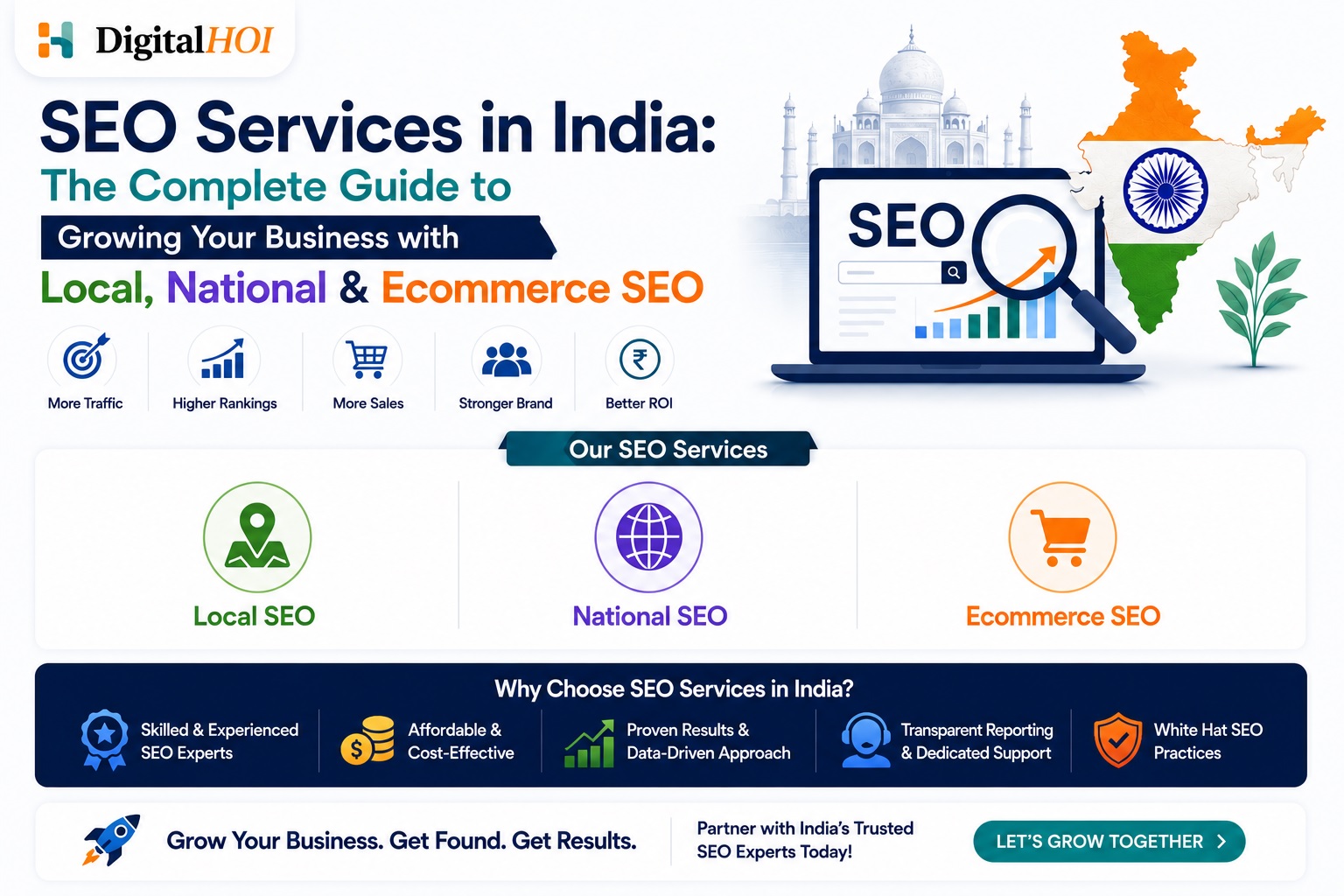
The three primary SEO service categories are:
-
Local SEO: For businesses serving specific cities, regions, or physical locations.
-
National SEO: For businesses targeting customers across India.
-
Ecommerce SEO: For online stores selling products through websites or ecommerce platforms.
- Enterprise SEO: For large websites, multiple locations, large product catalogs, and complex business structures.
Let's explore each in detail.
SEO Strategy for Different Types of Businesses
There is no universal SEO strategy.
The right approach depends on:
- Business model
- Target audience
- Location
- Industry
- Sales cycle
- Competition
- Website size
- Product or service complexity
- Conversion goals
Let's look at how SEO should be approached for different types of businesses.
Local SEO Services
What Is Local SEO?
Local SEO services focuses on improving a business's visibility in geographically targeted search results.
When users search for services near them, Google displays local businesses based on relevance, proximity, and authority.
Examples include:
-
Dentist near me
-
Digital marketing agency in Delhi
-
Restaurant in Mumbai
-
Interior designer in Bangalore
Local SEO helps businesses appear in:
-
Google Maps
-
Google Business Profile listings
-
Local search results
-
Mobile searches
Who Needs Local SEO?
Local SEO is ideal for:
-
Healthcare clinics
-
Dental practices
-
Law firms
-
Restaurants
-
Salons
-
Real estate agencies
-
Educational institutes
-
Home service businesses
-
Local retailers
How to Do SEO for Local Businesses
Step 1: Optimize Google Business Profile
Create and optimize the business's Google Business Profile.
Focus on:
- Correct business name
- Primary category
- Secondary categories
- Business description
- Address
- Phone number
- Website
- Opening hours
- Services
- Products
- Photos
Keep information accurate and consistent.
Step 2: Build Location-Specific Website Pages
Create relevant pages for important services and locations.
For example:
/dentist-bhubaneswar/
/root-canal-bhubaneswar/
Avoid creating low-quality city pages simply to target keywords.
Step 3: Build Local Citations
Maintain consistent business information across relevant:
- Business directories
- Industry directories
- Local websites
- Social profiles
Step 4: Generate Genuine Reviews
Encourage satisfied customers to leave authentic reviews.
Respond professionally to reviews and address customer concerns.
Step 5: Build Local Authority
Earn mentions and links from:
- Local publications
- Associations
- Community websites
- Local organizations
- Industry websites
Step 6: Target Local Search Intent
Examples:
- Dentist in Bhubaneswar
- Digital marketing agency in Delhi
- Best salon near me
- AC repair service in Mumbai
The goal is to connect search intent with location and service.
National SEO Services
What Is National SEO?
National SEO services targets customers across an entire country rather than a specific geographic area.
Businesses that serve customers throughout India often require national SEO strategies.
The goal is to rank for broad, high-volume keywords with nationwide relevance.
Examples include:
-
SEO services India
-
CRM software
-
Online accounting services
-
Business consulting services
Who Needs National SEO?
National SEO is ideal for:
-
SaaS companies
-
IT service providers
-
Digital marketing agencies
-
Online education platforms
-
Professional consulting firms
-
Nationwide service providers
How to Do National SEO
Step 1: Build a Keyword Strategy
Target:
- Commercial keywords
- Informational keywords
- Industry keywords
- Product keywords
- Service keywords
- Long-tail keywords
Example:
Instead of targeting only:
SEO Services
Build a keyword ecosystem around:
- SEO services in India
- SEO company India
- technical SEO services
- ecommerce SEO services
- enterprise SEO services
- local SEO services
Step 2: Build Topic Clusters
Create a pillar page supported by detailed cluster content.
For example:
SEO Services in India
↓
Local SEO
National SEO
Ecommerce SEO
↓
Supporting articles
This creates topical depth and stronger internal linking.
Step 3: Create Industry-Specific Content
Develop content addressing the needs of your target industries.
For example:
- SEO for Healthcare
- SEO for Manufacturing
- SEO for SaaS
- SEO for Education
- SEO for Financial Services
Step 4: Build Authority
Acquire relevant links and mentions from:
- Industry publications
- Business websites
- Associations
- News platforms
- Relevant blogs
Step 5: Optimize for Commercial Intent
Create service pages that clearly explain:
- What you offer
- Who it is for
- How it works
- Expected outcomes
- Your expertise
- Case studies
- FAQs
Ecommerce SEO Services
What Is Ecommerce SEO?
Ecommerce SEO focuses on optimizing online stores to improve visibility for product and category-related searches.
The objective is to increase organic traffic and drive more sales without relying solely on paid advertising.
Examples include:
-
Buy running shoes online
-
Best smartphones under ₹20,000
-
Men's formal shirts online
Who Needs Ecommerce SEO?
Ecommerce SEO is ideal for:
- Shopify stores
- WooCommerce stores
- Magento stores
- Custom ecommerce websites
- D2C brands
- Online marketplaces
How to Do Ecommerce SEO
Step 1: Optimize Category Pages
Target broader commercial keywords.
Examples:
- Running Shoes
- Women's Clothing
- Office Chairs
- Wireless Earbuds
Category pages should contain:
- Optimized H1
- SEO title
- Meta description
- Supporting content
- Internal links
- Relevant products
Step 2: Optimize Product Pages
Every important product page should have:
- Unique product title
- Unique description
- Optimized images
- Product specifications
- Customer reviews
- FAQs
- Internal links
- Product structured data
Step 3: Fix Technical Ecommerce SEO
Monitor:
- Duplicate URLs
- Faceted navigation
- Pagination
- Canonicalization
- Indexation
- Redirects
- Broken links
- Sitemap issues
Step 4: Create Buying Guides
Examples:
- How to Choose Running Shoes
- Best Laptops for Students
- Office Chair Buying Guide
These pages capture informational and commercial search intent.
Step 5: Build Product Authority
Earn relevant links and mentions from:
- Product publications
- Review websites
- Industry blogs
- Influencers
- Digital PR campaigns
SEO for B2B Companies
B2B SEO requires a different approach because purchasing decisions are often complex.
Examples:
- Software companies
- Manufacturers
- IT service providers
- Consulting companies
- Industrial suppliers
- Engineering companies
Customers may research a business for weeks or months before contacting sales.
How to Do B2B SEO
Focus on:
- Industry-specific keywords
- Product/service keywords
- Technical content
- Case studies
- Whitepapers
- Comparison pages
- Buyer guides
- Problem-focused content
For example, a manufacturer could create content around:
Automotive Component Manufacturing
with supporting topics such as:
- Automotive component suppliers in India
- OEM component manufacturing
- Automotive manufacturing quality standards
- Automotive supply chain solutions
The objective is to build authority before the buyer reaches the sales stage.
SEO for SaaS Companies
SaaS SEO focuses heavily on solving problems through content and capturing high-intent software searches.
Target keywords may include:
- CRM software
- HR management software
- Project management software
- Accounting software
- AI automation software
SaaS SEO Strategy
Create:
Product Pages
Explain product capabilities and use cases.
Feature Pages
Target specific features.
Industry Pages
Example:
CRM Software for Healthcare
Comparison Pages
Example:
CRM vs Spreadsheet for Sales Management
Educational Content
Answer customer questions and problems.
Integration Pages
Target searches related to software integrations.
SaaS companies should connect content marketing with product-led conversion paths.
SEO for Healthcare Businesses
Healthcare SEO requires a strong focus on accuracy, trust, expertise, and user needs.
Examples include:
- Hospitals
- Clinics
- Diagnostic centers
- Healthcare technology companies
- Telemedicine platforms
- Health insurance businesses
Healthcare SEO Strategy
Focus on:
- Service pages
- Doctor or specialist pages
- Location pages
- Educational content
- Author credentials
- Medical review processes
- Trust signals
- FAQs
- Local SEO
For healthcare content, demonstrate who created or reviewed the content and use reliable sources where appropriate.
SEO for Educational Institutions
SEO can help schools, colleges, universities, coaching centers, and EdTech companies attract students and parents.
Target searches such as:
- MBA colleges in India
- Online MBA programs
- Best schools in Bhubaneswar
- Engineering colleges in India
- Online courses
Education SEO Strategy
Create:
- Course pages
- Program pages
- Location pages
- Admission guides
- Course comparison articles
- Career guides
- FAQs
SEO should connect informational searches with course discovery and enquiry conversion.
SEO for Real Estate Businesses
Real estate businesses often require both Local SEO and National SEO.
Target searches can include:
- Flats for sale in Bhubaneswar
- Commercial property in Delhi
- Residential projects in Bangalore
- Property developers in India
Real Estate SEO Strategy
Create optimized:
- Project pages
- Property listing pages
- Location pages
- Neighborhood guides
- Investment guides
- Market reports
Local search visibility is especially important for developers, brokers, and property service companies.
SEO for Financial Services
Financial businesses include:
- Banks
- NBFCs
- Insurance companies
- Loan providers
- Fintech companies
- Investment platforms
SEO strategies should focus strongly on credibility and accuracy.
Target:
- Product pages
- Loan pages
- Insurance pages
- Financial guides
- Calculators
- FAQs
- Eligibility content
Content should be written and reviewed with appropriate expertise and clear business information.
SEO for Manufacturing Companies
Manufacturing companies often overlook SEO because their customers are primarily businesses.
However, B2B buyers increasingly research suppliers online.
Manufacturing SEO Strategy
Create pages for:
- Products
- Manufacturing capabilities
- Industries served
- Applications
- Materials
- Certifications
- Locations
- Case studies
For example:
Automotive Components Manufacturer in India
can be supported by:
- Automotive component manufacturing
- OEM component supplier
- Precision engineering services
- Automotive supply chain solutions
SEO can help manufacturers reach procurement teams, engineers, distributors, and potential business partners.
SEO for Startups
Startups often need to balance limited marketing budgets with aggressive growth goals.
SEO can become a scalable acquisition channel when built correctly.
Startup SEO Strategy
Prioritize:
- High-intent keywords
- Product/service pages
- Bottom-of-funnel content
- Topic clusters
- Programmatic opportunities where appropriate
- Digital PR
- Conversion optimization
Startups should avoid trying to rank for every possible keyword.
Focus first on searches that can contribute directly to business growth.
SEO for Professional Services
Professional service businesses include:
- Lawyers
- Accountants
- Consultants
- Architects
- Marketing agencies
- IT consultants
- Recruitment firms
SEO should focus on demonstrating expertise and targeting service-specific searches.
Create:
- Service pages
- Industry pages
- Location pages
- Expert articles
- Case studies
- FAQs
Strong author profiles and proof of expertise can strengthen credibility.
The Core SEO Process We Follow
Regardless of industry, a successful SEO campaign should follow a structured process.
Step 1: Business & Market Analysis
Understand:
- Business model
- Products and services
- Target customers
- Locations
- Competitors
- Revenue goals
SEO should support the business strategy.
Step 2: SEO Audit
Analyze:
Technical SEO
- Crawlability
- Indexation
- Site architecture
- Page speed
- Core Web Vitals
- Mobile usability
On-Page SEO
- Titles
- Headings
- Content
- Internal links
- Images
- Metadata
Off-Page SEO
- Backlinks
- Referring domains
- Brand mentions
- Competitor authority
Step 3: Keyword Research
Identify keywords based on:
- Search volume
- Search intent
- Competition
- Business relevance
- Conversion potential
Do not select keywords based on search volume alone.
A keyword with 500 monthly searches and high purchase intent can be more valuable than one with 50,000 searches and no commercial relevance.
Step 4: Search Intent Analysis
Classify keywords into:
Informational
Users want to learn.
Navigational
Users are looking for a specific website or brand.
Commercial Investigation
Users are comparing options.
Transactional
Users are ready to take action.
SEO content should match the intent behind each search.
Step 5: Website Architecture
Create a logical hierarchy.
Example:
Home
↓
Services
↓
SEO Services
↓
Local SEO
National SEO
Ecommerce SEO
↓
Supporting content
This structure helps users and search engines understand the website.
Step 6: On-Page Optimization
Optimize:
- Title tags
- Meta descriptions
- H1-H6 headings
- Content
- URLs
- Images
- Internal links
- Schema markup
Avoid keyword stuffing.
Write primarily for users while making the page's subject clear to search engines.
Step 7: Technical SEO
Technical optimization includes:
- XML sitemap
- Robots.txt
- Canonical URLs
- Redirect management
- Structured data
- Mobile optimization
- Page speed
- JavaScript rendering
- Indexation management
Technical SEO is particularly important for large websites and ecommerce stores.
Step 8: Content Strategy
Create content based on customer questions and business opportunities.
A strong content strategy can include:
- Pillar pages
- Cluster articles
- Service pages
- Industry pages
- Location pages
- Case studies
- Guides
- FAQs
The objective is to build topical authority rather than simply publish large volumes of articles.
Step 9: Internal Linking
Connect related pages strategically.
For example:
SEO Services in India
links to:
- Local SEO Services
- National SEO Services
- Ecommerce SEO Services
Those service pages then link to relevant supporting articles.
This creates a strong topic cluster.
Step 10: Authority Building
Develop authority through:
- Quality backlinks
- Digital PR
- Industry publications
- Partnerships
- Original research
- Expert contributions
- Brand mentions
Quality is more important than backlink quantity.
Step 11: Conversion Optimization
SEO traffic is valuable only when it contributes to business outcomes.
Optimize:
- Contact forms
- CTA placement
- Landing pages
- Service pages
- Product pages
- Phone calls
- Enquiry forms
- Booking flows
A high-ranking page with no conversions is not a successful business asset.
Step 12: Measure and Improve
Track:
- Organic traffic
- Keyword visibility
- Search impressions
- Click-through rate
- Leads
- Sales
- Revenue
- Conversion rate
- Assisted conversions
SEO should continuously evolve based on data.
How Long Does SEO Take?
SEO is a long-term strategy.
Typical timelines include:
Months 1-3
-
SEO audit
-
Technical improvements
-
Keyword research
-
Initial content optimization
Months 3-6
-
Improved rankings
-
Increased traffic
-
Lead growth
Months 6-12
-
Significant ranking improvements
-
Authority growth
-
Strong ROI
Results vary depending on competition, website history, and industry.
How Much Do SEO Services Cost in India?
SEO pricing depends on:
-
Industry competition
-
Website size
-
Business objectives
-
Service scope
Typical SEO investment ranges:
Local SEO
₹10,000 – ₹40,000 per month
National SEO
₹25,000 – ₹1,00,000+ per month
Ecommerce SEO
₹30,000 – ₹2,00,000+ per month
Businesses should focus on value, expertise, and long-term results rather than choosing solely based on price.
How to Choose the Right SEO Company in India
When selecting an SEO partner, consider:
Experience
Look for industry expertise and proven success.
Transparency
Choose agencies that provide clear reporting and communication.
Customized Strategies
Avoid one-size-fits-all SEO packages.
Ethical SEO Practices
Ensure the agency follows white-hat SEO techniques.
Performance Tracking
Data-driven reporting is essential for measuring success.
The Future of SEO
Search is evolving rapidly.
Emerging trends include:
-
AI-powered search experiences
-
Google AI Overviews
-
Voice search optimization
-
Entity-based SEO
-
Generative Engine Optimization (GEO)
Businesses that adapt early will gain a significant competitive advantage.
Conclusion
SEO remains one of the most powerful digital marketing investments for businesses in India.
Whether your goal is attracting local customers, expanding nationwide visibility, or increasing ecommerce sales, a well-planned SEO strategy can deliver sustainable growth and long-term ROI.
The key is selecting the right SEO approach:
-
Local SEO for location-based businesses
-
National SEO for companies serving customers across India
-
Ecommerce SEO for online stores seeking organic sales growth
By combining technical optimization, content marketing, authority building, and user-focused experiences, businesses can establish strong online visibility and outperform competitors in an increasingly competitive digital landscape.
Investing in professional SEO services today can create lasting growth opportunities for years to come.
Author Bio
Sachikanta Mohanty – Digital Marketing Manager & Lead Strategist, High-On Innovation
Sachikanta Mohanty is the Digital Marketing Manager and Lead Strategist at High-On Innovation, leading digital growth initiatives for both internal brands and client projects. He specializes in SEO, content strategy, lead generation, performance marketing, and online brand growth, helping businesses improve search visibility, customer acquisition, and long-term digital performance.
With experience across multiple industries, Sachikanta develops data-driven marketing strategies that combine SEO, content marketing, and performance-focused campaigns to deliver measurable business results. He is also actively involved in emerging search technologies, including AI-driven search, Answer Engine Optimization (AEO), and Generative Engine Optimization (GEO), helping businesses stay ahead in an evolving digital landscape.
Areas of Expertise: SEO Strategy, Local SEO, National SEO, Ecommerce SEO, Content Marketing, Lead Generation, Performance Marketing, Digital Transformation, Search Visibility Growth, AEO & GEO Strategy, and Online Brand Development.